

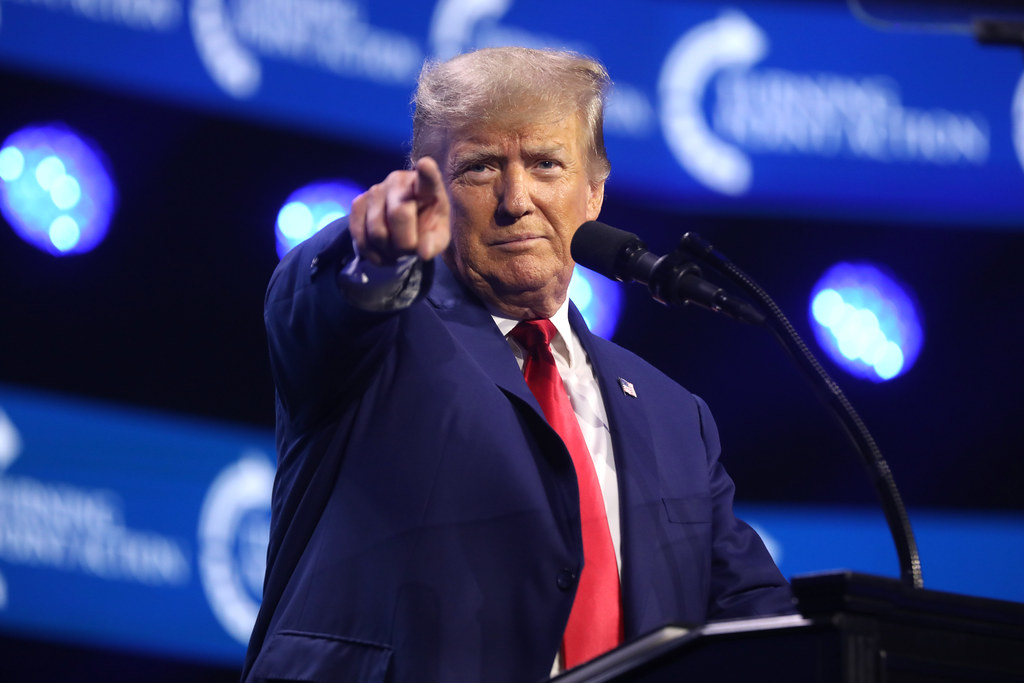
The press corps has been gunning for President Trump since the moment he returned to the White House.
He fired back — and the media machine is treating it like a constitutional crisis.
And one reporter tried a “gotcha” question, and what happened next sent the establishment press into full meltdown mode.
What Actually Happened on That Dallas Tarmac
President Trump had just wrapped up the Republican Midterm Convention in Dallas, where he announced his “Trump Dividend” — a promise to send every adult American citizen $5,000 if Republicans hold both the House and Senate in November’s midterm elections.
“If the Republicans win, you win with us and you get $5,000,” Trump told the crowd. “It will be called the Trump dividend.”
The idea is straightforward: tariff revenue has been pouring into the federal government, and Trump wants to return a portion of that money directly to the American people as a reward for standing with him through years of Biden-era economic destruction.
On the airport tarmac afterward, ABC News senior political correspondent Rachel Scott pressed the President on the plan. Her question: “If your economic policies are working, why do you need an incentive for people to turn out to vote?”
Trump pushed back immediately.
“I didn’t do it for turning out to vote,” he said. “I’m doing it as a reward for people having to put up with five years, and four years, of a horrible, horrible situation caused by Biden.”
He added that the payment was “almost a reward for the people having to put up with Biden’s policy” — pointing to the border crisis, crime, and the broader economic wreckage the Biden administration left behind.
Scott then tried to follow up by raising the $2,000 tariff refund checks Trump had floated earlier — checks that have not yet gone out. Trump cut her off. “Not you,” he said. Then again: “Not you.” And once more: “Hey, not you.” He then turned to another reporter, and as that reporter began to speak, Trump looked back at Scott and said, “Your network and you, you’re the worst.”
That exchange is now plastered across every left-wing media outlet in the country as proof of something sinister.
The Dividend Itself Deserves More Attention Than the Tarmac Theatrics
The press wants to talk about Trump’s tone. The more interesting question is what the Trump Dividend actually represents and why the political class is so rattled by it.
Vice President JD Vance went on Fox News to defend the proposal, saying the money would come at least in part from tariff revenue. “We’re taking in an extraordinary amount of revenue because the president of the United States is actually standing up to both foreign companies but also foreign countries who have been taking advantage of America’s workers for pretty much my entire life,” Vance said. “I don’t think it’s a controversial idea.”
And he’s right that it isn’t controversial to the millions of Americans who spent four years watching their grocery bills explode, their gas prices spike, and their wages eaten alive by Biden-era inflation. Those people endured real economic pain. The idea that the government, flush with tariff revenue generated by Trump’s trade enforcement agenda, might return some of that money to the people who bore the cost of decades of bad trade deals is not an outrage. It’s a logical extension of the America First economic argument.
The tariff trade enforcement framework has been generating revenue. Trump previously floated a $2,000 tariff dividend earlier in his term, and Treasury Secretary Scott Bessent indicated at the time that any such payment would require congressional action. The $5,000 figure announced at the convention is larger and carries its own legislative and logistical questions. Those are fair questions to ask. What isn’t fair is pretending the entire concept is nothing more than a vote-buying scheme while ignoring the economic case behind it.
Scott’s framing — “why do you need an incentive for people to turn out to vote?” — assumed the only reason to put money back in Americans’ pockets is electoral desperation. Trump rejected that framing directly. Whether one agrees with his answer or not, it was a substantive response to a loaded question.
The Real Story the Media Is Burying
Rachel Scott is a credentialed White House correspondent doing her job. Asking pointed questions about a major policy proposal is exactly what reporters are supposed to do. Nobody disputes that.
But the media coverage of this exchange tells a story about the press that the press would rather not examine. Within hours, clips of the tarmac moment were everywhere, framed as evidence of Trump’s instability, his hostility to women, his authoritarian tendencies. The actual policy question — whether a $5,000 dividend funded by tariff revenue is feasible, desirable, or constitutional — got approximately one-tenth the coverage of the tone of the exchange.
That is a choice. And it’s the same choice the establishment press makes every time Trump pushes back on a reporter. The content of what he says gets buried under the optics of how he says it.
The tariff trade enforcement agenda has real consequences — for domestic manufacturers, for supply chains, for the cost of imported goods. Those are legitimate stories. The $5,000 dividend carries real fiscal questions worth examining. Newsweek noted the total price tag could reach roughly $1.22 trillion based on the estimated 245 million adult American citizens who might qualify. Those numbers deserve scrutiny.
But scrutiny requires engaging with the substance. What the media delivered instead was a clip show.
And here is what gets lost entirely in the coverage: the Biden years were genuinely brutal for ordinary Americans. Trump’s framing of the dividend as a “reward” for enduring that period isn’t just political spin. Inflation under Biden hit 40-year highs. The border was effectively open. Crime surged in major cities. Energy prices hammered working families. The people who lived through that aren’t wrong to feel they were owed something, and a President saying so out loud is not a scandal.
The press treated Scott’s question as if it were unanswerable. Trump answered it. His answer may be debated. But the media’s decision to make the exchange about the temperature of his voice rather than the content of his reply tells the audience more about the press than it does about the President.
The establishment media has spent years insisting it asks hard questions in the public interest. When those questions get a sharp answer, the story becomes the sharpness. That’s not journalism. That’s performance.
And the American people — the ones who sent Trump back to Washington in 2024 with a clear mandate — can see the difference.
Sources: Mediaite; PBS NewsHour; Newsweek; The Hill; Newser; americanewsnation.com; IBTimes UK