

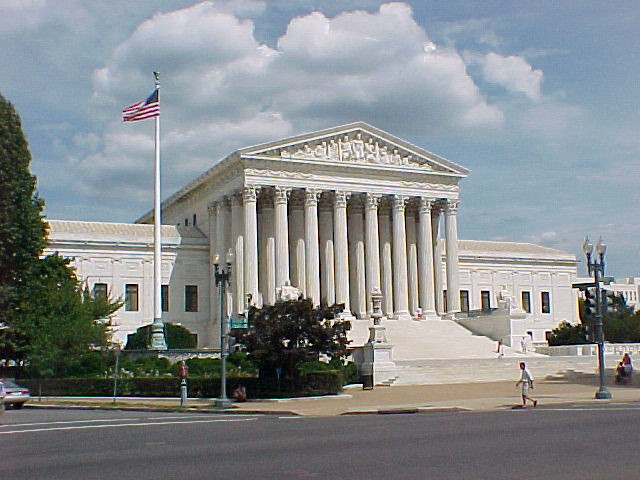
The Supreme Court just gave Republicans a major boost with November eight weeks away.
Democrats went to court trying to kneecap the GOP’s financial edge before the midterms.
And the high court’s ruling left them flat-footed at the worst possible moment in the 2026 election cycle.
What the Court Actually Did
The Supreme Court granted an emergency stay requested by the National Republican Congressional Committee and the National Republican Senatorial Committee, clearing a legal obstacle that would have forced Republican party committees to pay full commercial rates for broadcast television advertising in the run-up to the November 3 midterm elections.
The court issued a four-page unsigned order halting a ruling by the US Court of Appeals for the Fourth Circuit, which had struck down a Federal Communications Commission policy that extended so-called “lowest unit charge” rates to political party committees and certain joint fundraising committees, not just candidates themselves.
The FCC’s Media Bureau had issued a public notice in March 2026 telling broadcasters that the discounted rates applied to coordinated party advertising alongside candidates. That window — which federal law triggers 60 days before a general election — opened the same day the Supreme Court acted.
The vote was 8-1.
Justice Ketanji Brown Jackson was the lone dissenter. She wrote a one-paragraph dissent arguing the Republican committees were “not likely to succeed” on the jurisdictional question, contending that an agency cannot block judicial review simply by refusing to act on a complaint.
But eight of her colleagues disagreed.
How Democrats Tried to Use the Courts to Close the Money Gap
The lawsuit that triggered this whole fight was brought by four Democrat candidates: former US Senator Sherrod Brown of Ohio, US Senator Jon Ossoff of Georgia, former North Carolina Governor Roy Cooper, and US Representative Kristen McDonald Rivet of Michigan. Brown, Ossoff, and Cooper are running for Senate seats; McDonald Rivet is seeking reelection to the House.
Their argument was straightforward: the discounted broadcast rates exist to help candidates, not parties, and the FCC’s March guidance improperly extended that benefit to party committees and joint fundraising operations. The Fourth Circuit agreed with them in a 2-1 ruling in late August, striking down the FCC notice and triggering the emergency appeal to the Supreme Court.
The Republican committees pushed back hard. Their lawyers argued the Fourth Circuit had no jurisdiction to strike down what was essentially a staff-level guidance document that had not gone through the full Commission’s formal rulemaking process. They also argued the ruling unconstitutionally restricted their political speech. “Every day its judgment remains in effect means fewer voters they can reach,” their attorneys wrote in the emergency application.
The Supreme Court tentatively agreed that the Fourth Circuit likely lacked jurisdiction to review the FCC notice in the first place, which is why the stay was granted. The underlying legal question about whether party committees are genuinely entitled to the lowest unit charge rates remains unresolved.
The Trump administration backed the Republican committees throughout the litigation. The FCC and the Department of Justice filed briefs supporting the emergency application, with the administration arguing the FCC guidance applied universally and did not unfairly advantage one side over the other.
The National Republican Congressional Committee has already reserved $10.8 million in television ads for 23 House races this month alone, according to the committee and AdImpact.
Why This Ruling Matters Beyond the Courtroom
The money gap here is not trivial. According to Federal Election Commission filings, the top three Democrat committees held roughly $136 million in cash at the end of July. The major Republican committees held nearly $279 million — more than twice as much.
And this ruling does not exist in isolation. Earlier this year, the Supreme Court struck down federal limits on coordinated spending between political parties and candidates, opening the door to unlimited coordination. Pair that with access to candidate-level ad rates, and Republican party money stretches considerably further than it otherwise would.
Democrats understood exactly what was at stake when they filed their lawsuit. The Fourth Circuit ruling was a direct attempt to level a financial playing field that Republicans have built through superior fundraising. When that ruling came down, broadcast stations began rescinding the discounted rates almost immediately. The window to lock in those rates was closing fast.
But the Supreme Court stepped in before the damage became permanent for this cycle.
It is worth stepping back to note what actually happened here. Four Democrat Senate and House candidates went to federal court seeking an order that would force their opponents’ party committees to pay higher prices for political speech. The court they ran to obliged them. The Supreme Court then reversed that ruling by a margin of eight to one.
The legal question about whether the FCC’s interpretation of the lowest unit charge statute is correct will likely come back before the courts. The stay is not a final ruling on the merits. But for the 2026 midterms, the discount window is open, and Republican committees can use it.
Democrats spent months trying to neutralize the GOP’s financial advantage through litigation rather than fundraising. The result is that they burned time and resources on a legal strategy that produced a single dissenting vote at the Supreme Court.
The underlying dynamic here is not going away. Republicans have consistently outraised Democrats at the party committee level, and the Supreme Court’s earlier ruling on coordinated spending combined with this stay on ad rates gives the NRCC and NRSC tools that amplify every dollar they raise. Democrat candidates in competitive races are heading into the final stretch of the midterm cycle with a party infrastructure that is outgunned financially and has now lost this legal fight as well.
The case is styled National Republican Congressional Committee v. Brown.
Sources: AP via Local10/NOTUS; CBS News; The Epoch Times; The Federalist; SCOTUSblog; Washington Examiner; Newsweek; The Hill; Inside Radio; Carolina Journal