

A senior citizen hands out free religious pamphlets on a public sidewalk in Louisiana. Police officers approach him brandishing handcuffs, tell him to stop, and warn him he will be arrested if he ever comes back.
Nobody touches the guy handing out radio station ads ten feet away. He walks off without a word from law enforcement.
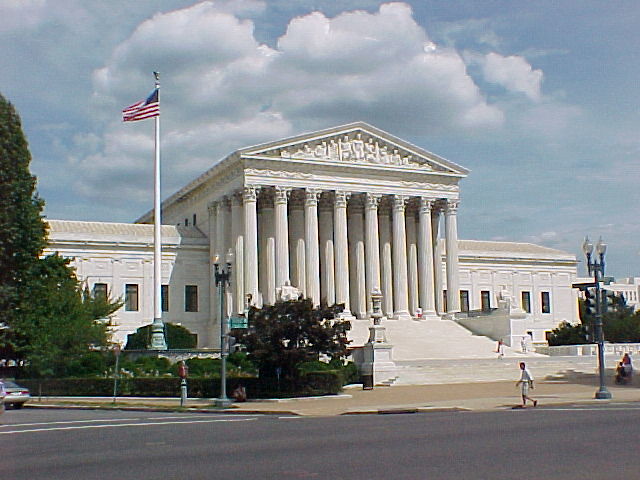
Now that case is heading toward the US Supreme Court, and two House Republicans want the justices to use it to fix a legal doctrine that has been letting government officials off the hook for obvious constitutional violations for years.
What Happened to Richard Hershey in Bossier City
Richard Hershey, a senior citizen, was peacefully distributing free literature from the Christian Vegetarian Association outside the Brookshire Grocery Arena in Bossier City, Louisiana. The arena sits inside a public park.
Court records show another person was also passing out literature — commercial ads for a radio station. None of the officers threatened him with arrest.
Officers approached Hershey while brandishing handcuffs. They told him to stop handing out the leaflets or face arrest. They claimed the area where he handed out the leaflets was private property and that he needed prior approval to pass out religious information.
Hershey left. But he didn’t let it go.
He later sued the city, two officers, and three security guards. He claimed the actions violated his First Amendment rights to free speech and free exercise of religion. The officers treated his religious message differently from commercial speech, he said.
A federal judge dismissed the case, prompting Hershey to appeal. In October 2025, a divided Fifth Circuit Court of Appeals panel issued a ruling. Two judges reversed the lower court’s dismissal but upheld qualified immunity for the officers and dismissed claims against the private security guards.
So the city gets to answer for its failure to train. But the officers who actually showed up with handcuffs and ran a Christian off a public sidewalk? They walk away clean.
Congress Steps In: Moran and Grothman File Amicus Brief
Representative Nathaniel Moran (R-TX) and Representative Glenn Grothman (R-WI) are leading an amicus brief supporting Hershey’s petition to the Supreme Court, arguing the justices should resolve a split among federal appeals courts over whether government officials can claim qualified immunity for obvious First Amendment violations.
“Mr. Hershey’s constitutional rights were treated as optional the moment officers decided to ignore them,” Moran told Fox News Digital. “The 5th Circuit’s ruling lets that stand, creating a circuit split that leaves citizens with a weaker right to free speech and right to religious free exercise, which is contrary to the Founders’ intent. The violation of these First Amendment rights should alarm everyone, regardless of politics or faith.”
The brief argues the Constitution protects Hershey’s sidewalk evangelism under both the free speech and free exercise clauses and maintains that qualified immunity should not shield officers from clear constitutional violations. It also says Congress intended Section 1983 to hold government officials accountable for infringing constitutional rights and maintains that differing rulings between federal appeals courts make Supreme Court review necessary.
First Liberty Institute and the law firm Clement & Murphy PLLC asked the US Supreme Court to review the 5th Circuit decision that shielded Louisiana government officials from liability after they stopped Hershey from handing out Christian vegetarian literature on a public sidewalk outside a public park.
His petition, filed with help from the First Liberty Institute and former Solicitor General Paul Clement, insists that the violation of his rights was obvious and that qualified immunity should not shield the officers from accountability. Hershey’s petition states, “The right to evangelize in public, free of viewpoint-based government suppression, is as clearly established as any right in the firmament.”
Hiram Sasser, executive general counsel at First Liberty Institute, told Fox News Digital, “A right without a remedy is effectively unenforceable. Americans deserve the right to hold government officials accountable when their First Amendment rights are violated.”
And Sasser went further. “If people cannot realistically sue when their First Amendment rights are violated, those rights lose meaning.”
The Qualified Immunity Problem Nobody Wants to Solve
Qualified immunity is a legal doctrine that protects government officials from civil lawsuits unless the specific right they violated was “clearly established” by prior case law. In theory, it protects officers making good-faith calls in difficult situations.
In practice, it has become a near-impenetrable wall in some circuits. Defenders of qualified immunity often argue that it is necessary to protect officers from liability for good-faith decisions made in challenging circumstances. But the cops who threatened Hershey “had no split-second, life-or-death decision to make,” the petition notes. “All the officers had to do to avoid liability was to do nothing.”
“Compelled by erroneous precedent, a Fifth Circuit panel granted qualified immunity to police and security officers who violated First Amendment rights that have been clearly established for decades.”
Even a judge on the 5th Circuit panel couldn’t stomach the result — but felt bound by his own court’s precedents anyway. Hershey’s claims “should have been amply sufficient to defeat qualified immunity at this preliminary stage of the proceedings” and “allow Hershey to proceed to trial,” Judge James Ho wrote in his concurring opinion. “After all, the Supreme Court has repeatedly denied qualified immunity where it found the constitutional violation so ‘obvious’ that it didn’t require the plaintiff to identify factually indistinguishable case law.”
Seven judges on the full 5th Circuit wanted to rehear the case. In an opinion joined by the six other dissenters, Judge Andrew Oldham chided Ho for opposing a rehearing. “According to Judge Ho, our court’s approach to qualified immunity in First Amendment cases is deeply flawed,” Oldham wrote. “If our precedent is that bad, however, we should obviously go en banc to overturn it. It’s surpassing strange to say, ‘our precedent requires persecution of Christians,’ and then say, ‘we should not go en banc to fix it!'”
That’s a federal appellate judge using the word “persecution.” Worth sitting with for a moment.
The petition before the Supreme Court puts it plainly: “There is simply no excuse for the government actions alleged in petitioner’s complaint. In any other circuit — and in the Fifth Circuit if he were a prisoner asserting mistreatment — his case could proceed.” It calls on the Court to “intervene and reaffirm that there is no novelty exception to the promise of Section 1983 when it comes to clearly established constitutional rights.”
Read that again. A prisoner complaining about mistreatment gets more legal traction in that circuit than a Christian man who was run off a public sidewalk for handing out pamphlets. That’s where the doctrine has landed.
The Manhattan Institute filed its own amicus brief alongside the Republican lawmakers. They argue that rights like leafletting in public areas have been settled for decades, if not centuries. Government officials should not get qualified immunity when the right is clear enough for a grade schooler to understand.
And the circuit split that Moran and Grothman point to is real. Different federal courts across the country apply the “obviousness” exception to qualified immunity in different ways, which means your ability to sue a government official for violating your First Amendment rights depends heavily on which state you happen to be standing in when it happens. That’s not how constitutional rights are supposed to work.
The Supreme Court has not yet decided whether to take up the case. But the breadth of support behind Hershey’s petition — Republican lawmakers, First Liberty Institute, former Solicitor General Paul Clement, and the Manhattan Institute — signals that this is a question the legal and political Right has decided it can no longer afford to leave unanswered.
Christians exercising their faith in public spaces have faced this kind of bureaucratic squeeze for years. Local governments and their security contractors have learned that threatening arrest is often enough to make the problem go away, and that even when someone is willing to fight back in court, the doctrine of qualified immunity can keep the case from ever reaching a jury. Hershey refused to disappear quietly, and now the question is whether the highest court in the country will give him — and everyone else in his position — a real remedy.
Sources: Fox News Digital; Reason; Townhall; Cato Institute; Manhattan Institute; Religion Clause; CaseMine; MBLB Municipal Law