

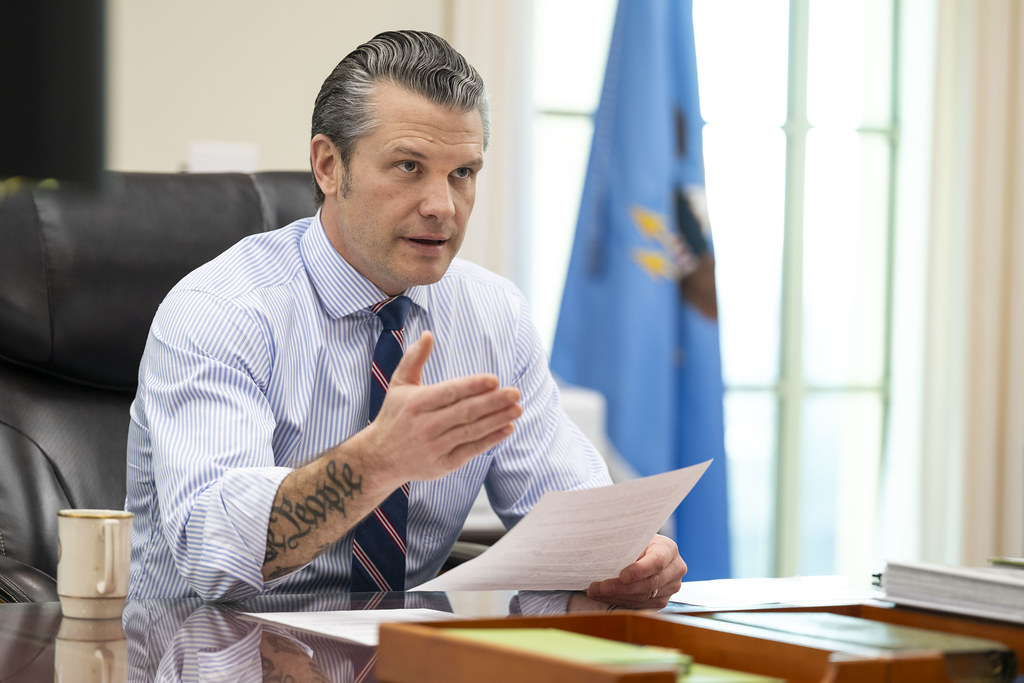
Pete Hegseth has been hunting the people who keep feeding Pentagon secrets to the press.
His critics call it a purge, and some of the brass are quietly telling reporters the same thing.
And one three-star general just found out how far Hegseth plans to take it.
A 32-Year Career Ended in a Justice Department Referral
Hegseth fired Army Lt Gen Brett Sylvia in late October 2026 and pulled him out of one of the most sensitive offices in the building.
Sylvia ran the Joint Staff’s Directorate for Strategy, Plans and Policy, the shop insiders call the J5. He reported to Gen Dan Caine, the Chairman of the Joint Chiefs of Staff. He had held the job for about 11 months, after commanding the 101st Airborne Division at Fort Campbell, Kentucky.
The Atlantic broke the news of the firing. A day later, the Pentagon sent the case to the Justice Department.
Chief Pentagon spokesman Sean Parnell never typed Sylvia’s name. He didn’t need to.
“The Department of War has zero tolerance for the intentional, unauthorized disclosure of classified information,” Parnell wrote on X. “Anyone who compromises sensitive national security information puts the lives of our Warriors at risk and undermines every military operation that keeps our country safe.”
Parnell said the department acted “Following an extensive Air Force OSI investigation.” Then he closed with a line meant for anybody in the building who still keeps a reporter’s number saved in his phone.
“Our commitment was not an empty promise. We vowed to find you, and we meant it.”
A defense official told The Washington Post that the statement referred to Sylvia. Another Pentagon official laid out the accusation in plainer English to Al Jazeera, saying the general had been “meeting with journalists outside the Pentagon in order to leak classified information.” ABC News and CBS News reported that the alleged leaks involved Iran and the war in Ukraine.
That same official made a second claim. “Sylvia failed three polygraphs which questioned him about leaking classified information,” the official said.
Nobody has charged Sylvia with a crime. One of his colleagues told the Post that the general has repeatedly denied leaking classified information, though he acknowledged past interactions with journalists.
President Trump didn’t sound like a man waiting on the paperwork. Asked about the firing, he told reporters the general was “going to have big problems. Long-term problems.”
The Press Walked Out, and the Conversations Moved Elsewhere
Here’s the detail the cable shows will race right past.
In October 2025, reporters from nearly every major outlet turned in their Pentagon badges rather than sign Hegseth’s new press rules. The policy warned that reporters who pressed employees for classified or controlled information could lose their credentials as security risks. The New York Times, the Associated Press, and even Fox News refused to sign.
Hegseth didn’t blink. “The ‘press’ does not run the Pentagon,” he posted.
The newsrooms cried censorship. But they also promised the walkout wouldn’t slow down their coverage one bit. One member of the Pentagon Press Association told Reuters, anonymously, naturally, that the sensitive conversations weren’t happening in the hallways anyway. They were happening on Signal.
Read that one again. Reporters were practically bragging that the building’s rules couldn’t touch them, because the real talk happened somewhere else.
Now a Pentagon official says a three-star general was meeting journalists outside the building.
Maybe that’s coincidence. But it lines up awfully neatly with the arrangement those reporters described on their way out the door.
And let’s be clear about who carries the legal burden here. The press keeps its First Amendment rights whether it works out of a Pentagon cubicle or a Starbucks in Crystal City. The duty to guard a secret belongs to the officer who signed the nondisclosure agreement and swore the oath. If the Pentagon’s case holds up, that officer is the one with the problem.
A Defense That Showed Up on Background
Then came the part that would make a sitcom writer jealous.
Within hours, unnamed colleagues started telling reporters the Pentagon’s story didn’t add up. The Post wrote that the firing stunned many of Sylvia’s colleagues and left some of them questioning the narrative from Hegseth’s team. A former Joint Chiefs official told The Atlantic, “Now is not the time when you’d want to lose the J5.”
Not one of them attached a name.
So the defense of a general accused of talking to reporters off the record arrived, right on schedule, off the record.
The Atlantic billed Sylvia as the Pentagon’s chief planner, which made it sound like the Iran effort had just lost its brain. A Department of War official pushed back hard, telling The Gateway Pundit that Sylvia “was NOT a central planner for the Iran War.” The official added, “That is the responsibility of CENTCOM and its commander Admiral Cooper.”
Even the Joint Staff changed its tune. Its first statement offered Sylvia its “deepest gratitude” for his “distinguished” service. A revised statement followed later, according to ABC News.
Washington Has Watched This Movie Before
Hegseth has fired at least 27 generals and admirals and blocked or held back roughly 55 promotions, according to the Post. The paper reports those numbers like a rap sheet. Plenty of folks who voted for Donald Trump read them as a cleanup crew finally showing up for work.
Tulsi Gabbard put a label on the problem back in April 2025, when she sent her own leak cases to the Justice Department. “These deep-state criminals leaked classified information for partisan political purposes to undermine POTUS’ agenda,” the Director of National Intelligence wrote.
Now, Hegseth’s leak hunts haven’t always ended with a tidy bow on top. That same month, he fired three senior aides, Dan Caldwell, Colin Carroll, and Darin Selnick, during an earlier probe. Prosecutors never charged any of them, and the three said nobody ever told them what investigators were after. A polygraph isn’t a conviction, either. Courts generally keep those results away from juries for good reason.
So Sylvia deserves his day in court if prosecutors ever bring a case. That’s how this country works.
But consider where the J5 sits. That office generates and coordinates military plans for the Chairman and the President. Leaks about Iran and Ukraine land smack in the middle of the most delicate decisions any Commander in Chief makes, from ending the bloodshed in Ukraine to whatever comes next with Tehran. Whoever leaks from a desk like that hands Moscow and Tehran a peek at America’s hand before the cards hit the table.
And Washington has seen how the old establishment handled this kind of thing. Retired Marine Gen James Cartwright, once the second-highest-ranking officer in the US military, pleaded guilty in October 2016 to lying to the FBI about his conversations with reporters over a classified operation targeting Iran’s nuclear program. Barack Obama pardoned him in January 2017, before a judge ever handed down a sentence.
Every officer in the building noticed that message.
Hegseth is sending a different one.
Nobody has said yet which reporters sat across the table from Sylvia at those alleged meetings outside the building. That’s one secret the newsrooms seem in no hurry to share.
Sources: Mediaite; The Washington Post; ABC News; CBS News; Al Jazeera; Stars and Stripes; The Atlantic; The Gateway Pundit; The Hill; Associated Press; NPR; Reuters; Foundation for Individual Rights and Expression; US Department of Justice