

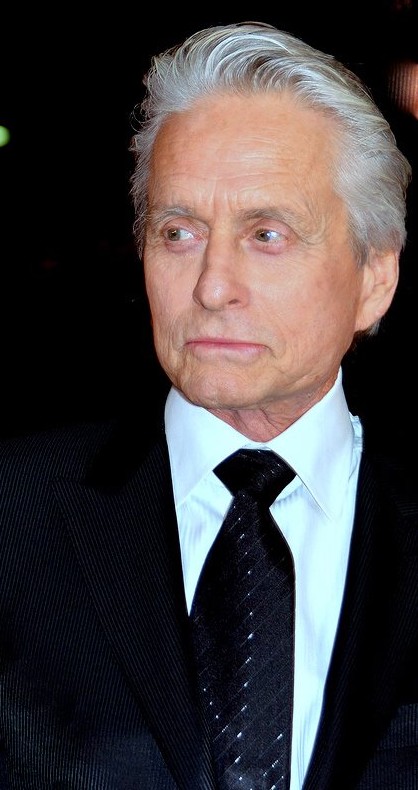
Michael Douglas says old Hollywood never needed a babysitter on set because actors trusted each other.
Hollywood’s new compliance crowd treats that kind of talk like a relic from the VHS era.
And Douglas just learned one woman from his early years tells the story very differently.
The Wall Street Legend Who Never Needed a Hall Monitor
Douglas, now 82, sat down recently with Josh Horowitz on the Happy, Sad, Confused podcast. The two of them talked shop about the scenes that made him one of the biggest box office draws of the 1980s and 1990s.
He didn’t blush one bit. “There’s an art to sex scenes in films,” Douglas said.
And the art, the way he tells it, comes down to one old-fashioned ingredient. “But the big thing with sex scenes is trust,” he said, adding that the whole thing works “like a dance. You’re taking the lead.”
Douglas walked Horowitz through the routine. The two actors talk over every move, out loud and slowly, before anybody calls action. Then they run it the way stuntmen rehearse a bar brawl. “You do it, and it’s just like choreographing a fight scene,” he said.
He also made a point the scolds rarely credit his generation for. Actresses in those days worked surrounded mostly by men, and Douglas said the goal was “to make sure that they were as comfortable as possible.”
Nobody needed a certificate to teach that. Fathers used to call it manners.
Hollywood Hired a Referee for the Love Scene
HBO wrote the new rules in October 2018, when the network announced it would put an intimacy coordinator on every production with intimate scenes. Netflix, Amazon, Hulu, and Starz soon jumped on board.
SAG-AFTRA rolled out formal standards and protocols in January 2020. Later, the coordinators voted to join the union themselves. A brand-new job category, complete with paperwork, accreditation, and union dues, popped up almost overnight.
But Douglas spotted the power shift right away. Back in 2024, he told Radio Times the trend “feels like executives taking control away from filmmakers.” He granted that some people behaved badly over the years. He just argued that the industry used to handle its own bad apples. “They would get a reputation and that would take care of them,” he said.
Here’s the funny part. During the early talks, the union itself passed along worries from some members that a coordinator might grab control away from the director. That’s the exact complaint Douglas made years later. The union signed on anyway.
And Douglas has company. Toni Collette told The Sunday Times in 2024 that the coordinators on her sets made her feel worse, not better. “It just felt like those people who were brought in to make me feel more at ease were actually making me feel more anxious,” she said.
Fran Drescher, then the union’s president, promised the whole system would help build “a more honorable industry.”
Honor sounds nice. But honor used to come from character, and no training course hands out character with the lanyard.
The Memoir Page One Actress Says Got It Wrong
This is where Douglas’ tidy story about trust gets tangled. He preaches trust on the soundstage. His memoir, One Helluva Ride, takes a looser approach to it off the set.
In the book, Douglas wrote that he and his married co-star on Adam at 6 AM, Lee Purcell, became lovers during filming early in his career. He wrote that they kept it “a secret from the cast, crew, the people in the town we were filming in, and of course her husband.”
Purcell read that and fired back. “This story came as a complete surprise to me,” she said in a statement to Fox News Digital. She kept it gracious, saying she has “fond memories” of him, before adding that “our recall appears to differ.”
Nobody outside that set more than half a century ago can say for certain whose memory holds up.
But look at what Douglas chose to print. He named a married woman, described her husband as the man left in the dark, and put it between hard covers for the whole country to read. Her own statement suggests she learned about it the same way the reading public did.
The book names another woman, too. Douglas wrote that he had a romance with Diane Thomas, the screenwriter behind Romancing the Stone, while his first marriage to Diandra came apart, and he wrote that both spouses carried on with other people at the time.
Thomas can’t offer her side. She died in October 1985, at just 39, in a crash in the Porsche that Douglas had given her as a thank-you for her work.
Old Hollywood Had a Code and Ignored Half of It
Douglas has a real point about the coordinators, and it deserves a fair hearing. Two professionals talking through a scene, a leading man who takes responsibility for his partner’s comfort, and a director who runs his own set built some of the best movies of that era.
And the modern alternative hands one more lever to studio executives who already control far too much of what Americans see.
But Hollywood didn’t invent the clipboard out of thin air. The same town that now assigns a chaperone to a kiss spent decades shrugging at affairs, broken marriages, and tell-all books that treat wedding vows like a punchline. People stopped trusting the old code partly because the folks who lived by it kept breaking it.
The compliance crowd’s rules only cover what happens between “action” and “cut.” They say nothing about a decades-old memory landing on a bookstore shelf with a married woman’s name attached.
Maybe that’s too hard on a man who survived Stage 4 cancer and wanted to tell his life story while he still can. Douglas didn’t spare himself in the book, either. He wrote openly about his rocky relationship with his father, Kirk, and about his son Cameron’s addiction and time behind bars.
But being honest about your own life and publishing your version of someone else’s marriage are two very different things.
Douglas told Horowitz he would “rather be good in a little movie than lousy in a big part.” It’s sound advice for an actor. It might make decent advice for a memoir writer too, where a smaller story told with care beats a juicy one somebody else has to correct.
Purcell didn’t call him a liar. She didn’t call him much of anything. She simply laid out her version in two short sentences, starting with “we had a strictly professional relationship during filming.”
Then came the kicker: “The personal one came much later.”
Sources:
“Michael Douglas gets explicit about how he filmed sex scenes before intimacy coordinators,” Fox News
“Michael Douglas feels intimacy coordinators take ‘control away from filmmakers,’” Fox News
“How Were Sex Scenes Filmed Before Intimacy Coordinators? Michael Douglas Is Here With An Explainer,” CinemaBlend
“Intimacy Coordinators Unionize With SAG-AFTRA,” The Hollywood Reporter
“Standards and Protocols for the Use of Intimacy Coordinators,” SAG-AFTRA (January 2020)
“Safe ‘Sex’ on Set: Inside Hollywood’s Push for Intimacy Coordinators,” TheWrap
“SAG-AFTRA Releases Intimacy Coordinator Registry,” TheWrap
“Romancing the Stone (1984),” AFI Catalog
“Romancing the Stone,” CrimeReads