

Donald Trump took questions for 90 minutes, and the liberal press keeps one lazy smear loaded for exactly that occasion.
Trump saw the cheap shot coming and swatted it away mid-answer.
And Laura Ingraham made one prediction about his critics that newsrooms won’t enjoy.
Laura Ingraham Went to Bat for the Trump Weave
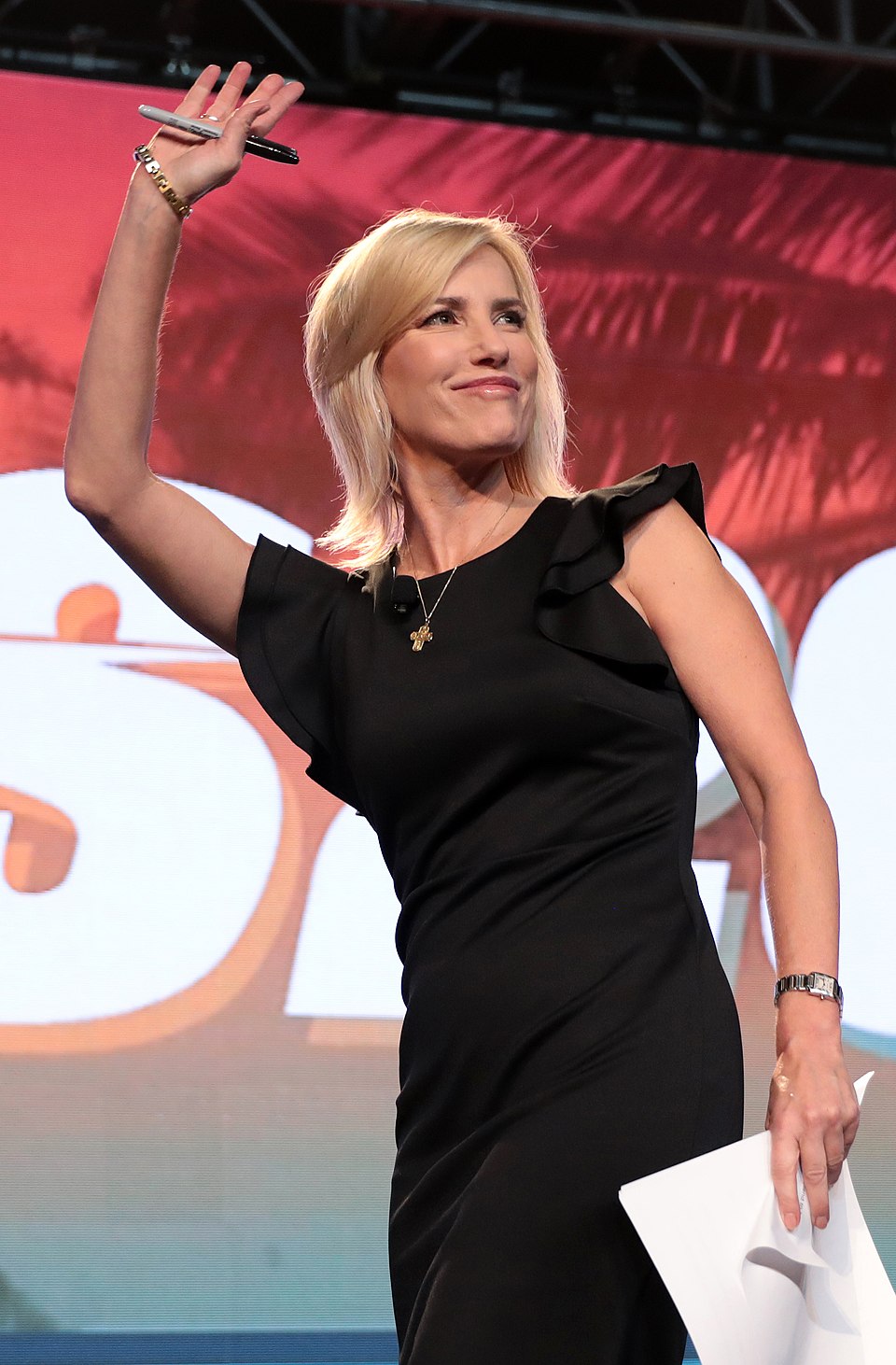
Laura Ingraham used a big chunk of The Ingraham Angle on Fox News to break down the marathon press conference Trump held after the APEC summit, where he sat down with Communist China’s Xi Jinping and Russia’s Vladimir Putin.
She didn’t pretend the President traveled in a straight line.
“Of course, it would not be a Trump press conference without some of the classic Trump weave,” Ingraham said.
Then she rolled the tape. In one stretch, Trump hopped from Dana White’s scheduled arrival on a brand-new helipad to his uncle, the MIT professor, to a round of praise for Mark Rutte and NATO, and finally to the business of protecting undersea cables.
Trump even called his shot on the critics before he finished the thought.
“I don’t want to bore you, they’ll say, ‘Oh, you rambled. He rambled terribly.’ I don’t ramble. I have a very good feel of it,” Trump said.
But the line that got Ingraham laughing came during the cable discussion. Trump told reporters, “I won’t say we do it, but we probably do it too.”
“I won’t say we do it, but we spy,” Ingraham said with a chuckle.
Anybody who ever sat across a Thanksgiving table from a favorite uncle knows how this works. The story wanders past the old pickup truck, detours through a fishing trip from 1974, and somehow lands exactly where he wanted it to. Nobody at the table calls a neurologist.
Joe Biden’s Note Cards Never Got This Kind of Scrutiny
Ingraham drew the obvious contrast, and she didn’t soften it.
“Biden clung to his notecards like they were life support,” she said.
That’s not much of an exaggeration. In June 2022, a photographer caught Biden holding a staff-prepared card for an offshore wind meeting that walked him through the event one step at a time. “YOU enter the Roosevelt Room and say hello to participants,” it read. The next line told him, “YOU take YOUR seat.”
And in April 2023, during a Rose Garden press conference with South Korean President Yoon Suk Yeol, cameras spotted another card carrying a Los Angeles Times reporter’s name, her photo, and a version of the question she went on to ask.
A President who needed written instructions to find his chair got a shrug from most of the press corps. Democrat leaders and White House aides swore up and down he was sharp as a tack, right up until a debate stage made the cover-up impossible.
But Trump talks without a net for an hour and a half, and suddenly every linguist in America wants airtime.
Trump explained his own method back in August 2024 at a rally in Johnstown, Pennsylvania. “You know, I do the weave,” he told the crowd. “I’ll talk about, like, nine different things, and they all come back brilliantly together.”
The experts lined up to sneer. Columbia linguist John McWhorter told NPR the habit amounted to the verbal equivalent of somebody being extremely drunk. Funny how that same crowd of credentialed language doctors never found the time to examine the man with the seating chart in his pocket.
Ingraham Named the Real Reason the Old Guard Can’t Stand Him
Ingraham’s sharpest point had nothing to do with grammar. It had to do with access.
“But what we were reminded today is that contrary to the media’s stereotype, Trump is open to talking to just about anyone,” she said. “He engages, he mixes it up, he occasionally insults, maybe unnecessarily.”
She argued Trump keeps every line of communication open until the last possible minute, and that habit drives the professional class up a wall.
“That’s the art of the deal. And that’s unsettling to the old guard, who prefer presidents who are supplicant rather than leaders on the world stage,” Ingraham said.
Then she twisted the knife. “They were usually wrong, after all.”
That’s the part the foreign-policy establishment hates hearing. The same experts who promised a quick war in Iraq, cheered on trade deals that shipped factory jobs to Communist China, and wrote blank checks for Ukraine now lecture Trump about whom he’s allowed to sit down with. Trump’s push to end the bloodshed in Ukraine runs straight through conversations they’d rather he never have.
Richard Nixon went to Beijing in 1972, and the phrase “only Nixon could go to China” entered the political dictionary. Talking to adversaries used to count as statesmanship. It only became scandalous once Trump started doing it without asking the old hands for permission.
“And they will never forgive him for not giving them a seat at the table,” Ingraham said.
Democrats, of course, have their own answer to the Trump problem. They pick up the gavels in January with subpoena lists already drafted, and their bench of 2028 hopefuls mostly speaks in poll-tested mush. This is the party that gave America Kamala Harris riffing about “what can be, unburdened by what has been.” The weave at least goes somewhere.
A Civil War Newspaper Already Tested Ingraham’s Theory
Ingraham saved her boldest claim for the end.
“But, 100 years from now, Trump’s critics will all be forgotten. But historians will still be writing volume, after volume, after volume about the fascinating age of Trump,” she said.
Bold? Sure. But the history books back her up more than the press would like.
On November 19, 1863, Abraham Lincoln delivered a short speech at the new cemetery in Gettysburg. A few days later, the Harrisburg Patriot & Union gave its verdict.
“We pass over the silly remarks of the President. For the credit of the nation we are willing that the veil of oblivion shall be dropped over them and that they shall be no more repeated or thought of,” the paper wrote.
Every schoolchild in America has heard those silly remarks. Almost nobody can name the editor who wrote that sentence.
In November 2013, the paper’s modern successor, the Patriot-News, finally ran a correction. It admitted the old editors missed the speech’s “momentous importance, timeless eloquence, and lasting significance.” The new staff even guessed their predecessors wrote the piece perhaps under the influence of partisanship, or of strong drink.
Lincoln took plenty of abuse in his own day, too, including for the long frontier yarns he loved to spin in the middle of serious meetings. General George McClellan, in a private letter to his wife, called the President “nothing more than a well meaning baboon.”
Is Trump the next Lincoln? Nobody needs to settle that over morning coffee, and the comparison can only stretch so far. The narrower point holds up fine. The press of any era makes a lousy judge of which presidents history will remember, and it usually picks the wrong side out of spite.
The Washington press corps can mock the weave all it wants. The 1863 crowd felt pretty confident too.
The Patriot & Union promised its readers that a veil of oblivion would fall over Lincoln’s words. The Patriot-News printed its correction 150 years later.
Sources: Mediaite, “Laura Ingraham Declares The ‘Fascinating Age of Trump’ Will Long Outlive His Critics”; NPR, “Breaking down former President Donald Trump’s rambling linguistic style” (September 2024); The Independent via AOL, on Trump’s “weave” remarks in Johnstown (August 2024); Washington Examiner and The Post Millennial, on Biden’s June 2022 Roosevelt Room cue card; CNN and Washington Free Beacon, on Biden’s April 2023 press conference note card; NPR, PBS NewsHour, UPI, and The Irish Times, on the Patriot-News retraction of its 1863 Gettysburg Address editorial (November 2013).