

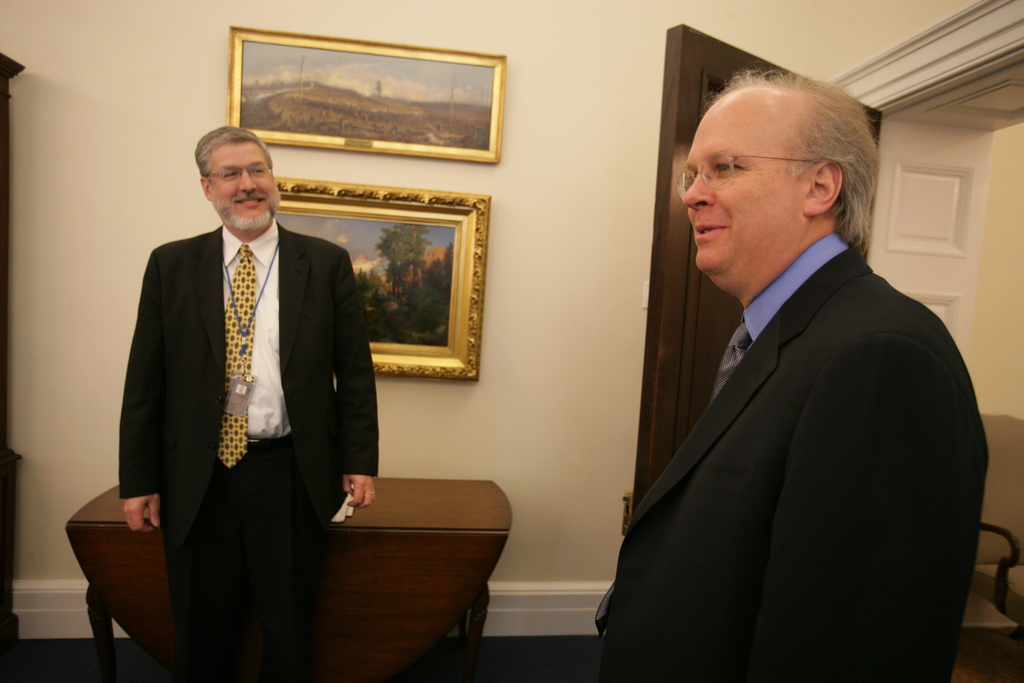
Karl Rove keeps telling Donald Trump to stay home and let somebody else carry the midterms.
The President keeps answering with packed arenas and one simple rallying cry.
And Rove’s newest warning skips right past the one campaign he’d rather nobody remember.
Karl Rove Took Aim at Trump’s Rallying Cry
Karl Rove, the man who ran George W Bush’s political shop, sat down on Fox News’ The Journal Editorial Report in the closing days before the November 3 midterms with a fresh gripe about President Trump.
This time his target was a phrase. For two months, Trump has told crowds from one coast to the other to “pretend I’m on the ballot.”
Rove thinks that line is a dud.
“With an approval rating in the mid-30s, pretending that he’s on the ballot appeals to the people who are already strongly in his corner and likely to turn out,” Rove said.
That approval number is Rove’s. Folks who remember his election-night math in 2006 and 2012 can decide how much weight it deserves.
Then Rove described the voters he really wants: the 13 or 14 percent of the 2024 electorate who, in his telling, held their noses and voted Trump anyway. He even scripted their thoughts for them.
“I’m not really a fan of Donald Trump. I don’t think he’s a good role model for our kids and our grandkids, but things were better when he was president and I can’t stand four more years of Biden-Harris. I want change,” Rove said, speaking for that bloc.
According to Rove, those voters have soured over affordability, the economy, “the unpopularity of the war,” and the President’s style. He brushed off the rallies as “another show at a big rally in which he says something that dominates the news, that is not central to the election.”
Trump had already given his own review of Rove. “He’s a loser,” the President told reporters in late October.
The Biggest Win of Rove’s Career Ran on the Opposite Plan
But Rove’s advice crashes headfirst into his own greatest midterm triumph.
In 2002, Rove sent President Bush barnstorming through the battleground states down the stretch. Bush hit 15 states in the final five days alone and visited 40 over the whole campaign, hauling in a record $140 million for Republican candidates along the way.
The University of Virginia’s Center for Politics later described that cycle as an election dominated by terrorism, Iraq, and the President himself.
Put plainly, Rove made Bush the issue. He built a midterm around one man whose name sat on no ballot anywhere in the country.
And it worked. Republicans gained seats in both the House and the Senate, and Bush became the first President since Franklin Roosevelt in 1934 to pick up ground in both chambers during his first midterm.
Rove’s defenders will point out that Bush carried a 63 percent approval rating that fall. Fine. But the strategy never hinged on coaxing a sliver of grumpy skeptics. It hinged on firing up the base and herding it to the polls, which is pretty much the whole ballgame in a midterm.
That’s the exact play Trump is running now. Only the name on the bus has changed.
The Iraq Salesman Suddenly Hates Unpopular Wars
Rove listing an unpopular war as a drag on Republicans takes real nerve.
He helped steer the White House operation that sold the country on Iraq. That war, along with the Wall Street meltdown and the bailouts that came after it, cost Republicans both chambers of Congress in 2006 and rolled out the red carpet for Barack Obama two years later.
Trump has taken the opposite road on Iran. A ceasefire that began April 8 halted the all-out fighting, and even after he declared that truce dead in July, the President agreed to keep negotiating with Tehran.
And the loudest pushback against a negotiated end hasn’t come from Trump’s voters. When word of an extended ceasefire leaked out, US Senator Roger Wicker (R-MS) warned it “would be a disaster.”
That’s the hawkish wing Rove grew up in. It cheers every new entanglement, then hands Trump the bill when voters get tired of the fighting.
Rove Wrote Off Trump’s Texas Pick Months Ago
None of this came out of nowhere.
Rove spent much of the cycle sniping at Ken Paxton, the Texas Attorney General Trump endorsed for the US Senate. Before the primary, Rove warned that a Paxton nomination could hand Democrats “the first Democratic victory since 1994, statewide, in Texas.”
And after Paxton knocked off US Senator John Cornyn (R-TX), Rove kept at it. At the Texas Tribune Festival in September, he told the crowd the race would already be over if Cornyn were the nominee, and he let everyone know Paxton had emailed him asking for help.
At that same event, Rove claimed the Republican Party was being taken over by “Nazis,” pointing at fringe figures like Nick Fuentes. Plenty of rank-and-file conservatives heard a familiar establishment sneer aimed a lot closer to home.
But Rove still hasn’t said whether he’ll vote for Paxton.
And Trump noticed. In mid-October, he made clear he’d hold Rove and Cornyn responsible if Paxton comes up short.
The Fight Rove Really Wants Starts After November
Strip away the polling talk, and Rove’s midterm advice reads like a rough draft of the post-Trump plan. Keep the President quiet. Run a generic Republican message. Chase the voters who apologize for their own ballots.
That approach always came bundled with a policy package: amnesty for illegal aliens, trade deals that shipped factory jobs overseas, and wars with no exit. Voters threw it overboard in 2016 and did it again in 2024.
The establishment wants it back anyway. And the man blocking the road is Vice President JD Vance, the clear America First heir for 2028, who opposes foreign wars and the open-borders policies that swap American workers for cheaper foreign labor.
Every time Rove tells Trump to sit down, he also tells the base its enthusiasm is a problem to be managed. Even the swing voters he quoted admitted that “things were better when he was president.” Those folks didn’t sign up for a Bush revival.
But the man scolding Trump for making himself the center of a midterm knows exactly how that play works, because he drew it up himself.
In the final five days of the 2002 campaign, Karl Rove sent a President whose name appeared on no ballot to 15 states, and Republicans gained seats in both chambers for the first time in a first-term midterm since 1934.
Sources: Mediaite, “Karl Rove Warns Trump His ‘Pretend I’m on the Ballot’ Midterm Strategy Isn’t Effective Amid Terrible Polling”; CNN transcripts, “President Bush Doing 10-State Campaign Blitz” and “American Votes 2002: Homestretch”; University of Virginia Center for Politics, Sabato’s Crystal Ball; American Journalism Review archive on 2002 midterm coverage; AFP via Ahram Online, “Trump says US agrees to more Iran talks but ceasefire ‘over’”; NBC Chicago, “Agreement on Iran war ‘largely negotiated,’ Trump says”; The Hill via KTSM, “Rove: Paxton primary win could deliver Texas Senate seat to Democrats”; The Texas Tribune via KERA, “Karl Rove says John Cornyn, not Paxton, could beat Talarico”; San Antonio Current, “Karl Rove says Republican Party is being taken over by ‘Nazis’”; The Texas Tribune, Trump Truth Social post on Cornyn and Rove