

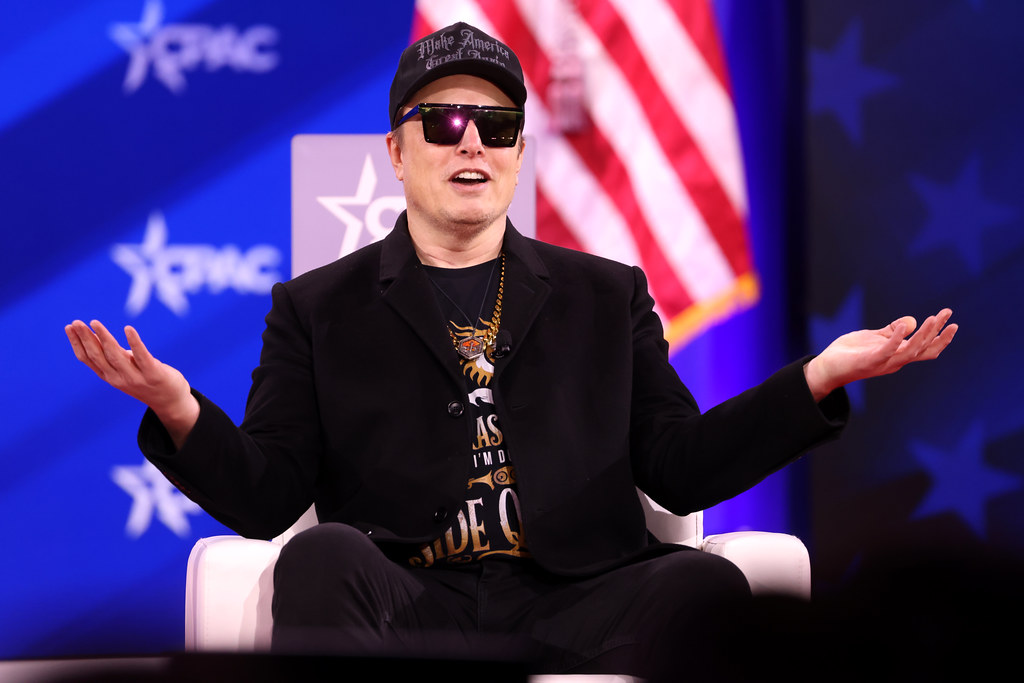
Elon Musk just put the Democrat Party on notice.
America PAC filed its first midterm spending disclosure, and the numbers tell a story about where this fight is headed.
And what Musk’s super PAC just dropped on the Federal Election Commission is going to have Democrats scrambling from Texas to Maine.
The Opening Salvo: $800,000 Across Seven Senate Races
America PAC filed disclosures with the Federal Election Commission showing more than $800,000 in spending during August, spread across seven competitive Senate races and eight House districts where Republicans are defending their congressional majorities.
All of it was categorized as printing expenses, meaning the money went toward direct-mail advertising aimed at reaching voters in their homes rather than on television screens.
The spending covered nearly all of the expected competitive Senate races this cycle: Texas ($247,595), Maine ($170,224.29), Ohio ($105,675), New Hampshire ($91,458.50), Iowa ($54,600), Michigan ($25,605) and Alaska ($17,235).
Texas got the biggest chunk by a wide margin. The largest share of the newly disclosed spending, more than $247,000, went to aid Republican Senate candidate Ken Paxton, the Texas attorney general who has been vastly outspent on the airwaves by Texas’ Democratic nominee James Talarico.
America PAC has been voicing its opposition to Talarico’s campaign on X, the social media platform owned by Musk, posting about the Democratic nominee multiple times, with the missives accusing Talarico of “running from his radical past” and masquerading as a moderate “to trick Texas voters into electing him.”
The fundraising gap in that race is stark. On fundraising, Talarico has far outpaced his rival, raising $72 million compared to Paxton’s $16.8 million this cycle. That kind of cash imbalance is exactly the kind of opening America PAC was built to help close, and it explains why Texas absorbed the largest portion of these initial dollars.
The Texas race deserves a closer look, given what’s at stake. The president, a longtime Paxton ally who endorsed him at the 11th hour in his primary, is sitting on a war chest of more than $400 million in his main super PAC, MAGA Inc. Senate GOP leaders have made clear in recent days that they plan to prioritize other states, putting the onus on Trump to help Paxton close the spending gap. That’s the establishment playing its usual game — pulling back when a MAGA-aligned candidate needs the most help, then expecting someone else to fill the breach.
Speaker Johnson Met With Musk in Texas, Then Played It Coy
House Speaker Mike Johnson confirmed to CBS News that he had met with Musk during a campaign swing in Texas, where several House districts are in play, in addition to a competitive Senate race between Republican Ken Paxton and Democrat James Talarico.
Johnson didn’t exactly open up about what they discussed. “He’s made public a lot of what he’s doing,” Johnson said to CBS News when asked about Musk’s plans. “I’m not going to talk about our conversation on that point, but we’re going to win the midterms.”
That’s a careful answer from a Speaker who knows how to play Washington. But the FEC filing speaks for itself.
The August spending by America PAC is likely just the opening salvo for the world’s wealthiest person, who spent hundreds of millions of dollars supporting President Trump and other Republican candidates in 2024. The New York Times reported in July that Musk had authorized America PAC to spend up to $120 million on a field program aimed at electing Republicans this November. Eight hundred thousand dollars against a potential $120 million commitment is barely a warm-up.
Andrew Romeo, a spokesperson for America PAC, put the committee’s posture plainly. “The president’s political team and the rest of the GOP apparatus have built a top-notch operation that will put Republicans in a strong position to buck history and retain control of Congress this fall, and we’re excited to again be part of the team,” he said.
House Races, Maine, and the Bigger Picture
Senate races weren’t the only targets. America PAC spent much less on House races, which are usually cheaper than statewide races, directing nearly $90,000 across eight contests. The spending benefited Republican Reps. Derrick Van Orden of Wisconsin, Mike Lawler of New York, Jen Kiggans of Virginia, Tom Kean Jr. of New Jersey, and Scott Perry, Rob Bresnahan and Ryan Mackenzie of Pennsylvania, as well as Republican Scott Singer, who is challenging Democratic Rep. Jared Moskowitz in Florida.
Maine is the other Senate race worth watching closely here. As Collins is the only Republican senator representing a state that President Donald Trump did not win in any of his three presidential campaigns, the race is considered to be among the most competitive in 2026. America PAC dropped more than $170,000 there to shore up incumbent US Senator Susan Collins (R-ME) against Democrat Troy Jackson.
And the establishment contrast in that Texas race cuts to the heart of what makes this political moment so interesting. While Senate GOP leaders are reportedly steering resources away from Paxton, Musk’s operation is moving in. That’s the pattern that has defined the MAGA era — when the institutional party hesitates, outside forces aligned with the America First movement step up. The GOP establishment appears more comfortable letting a MAGA-aligned nominee twist in the wind than going all-in to hold a Senate seat.
The activity marks a reengagement in Republican politics for Musk more than a year after he publicly bickered with President Donald Trump. At one point, he threatened to start his own political party before abandoning those plans and reconciling with Trump.
But reconcile he did, and the FEC filing shows the results. Musk, the world’s richest person, already is one of the biggest funders in the midterm elections, plowing more than $50 million into his America PAC and donating $10 million each to the main Republican super PACs active in House and Senate races. He also has given $10 million to a super PAC active in Kentucky’s Senate race.
The question Democrats have to answer right now is whether Talarico’s $72 million war chest can hold off a Musk operation that hasn’t even shifted into second gear yet. The $247,000 in Texas is a signal, not a ceiling. When America PAC starts deploying the kind of ground-game money it used in 2024 — door-knocking operations, digital targeting, voter registration drives — the arithmetic in these races changes fast.
Republicans enter these midterms defending their House and Senate majorities, and history says the party in the White House tends to lose seats in midterm cycles. But 2024 showed what organized outside money combined with a motivated base can do to historical patterns. The PAC has committed to helping Republicans retain their House and Senate majorities in November’s midterm elections, spending both to defend Republican-held seats and pick up districts now held by Democrats, according to a source familiar with the committee’s plans.
What the Democrats won’t say out loud is that their fundraising edge in individual races may not matter as much as they think if America PAC floods the zone with direct-contact voter outreach. Television ads are one thing. Mail programs that hit every competitive household in Texas week after week are something else entirely — and that’s where this initial $247,000 appears to be going.
The midterms are roughly two months out. The FEC filing covers only August. There will be more disclosures, and if the reported $120 million commitment holds, the numbers are going to look very different by October.
Sources: CBS News; The New York Times (via CBS News); Federal Election Commission filing; NBC News; CNBC; The Hill; Texas Tribune