

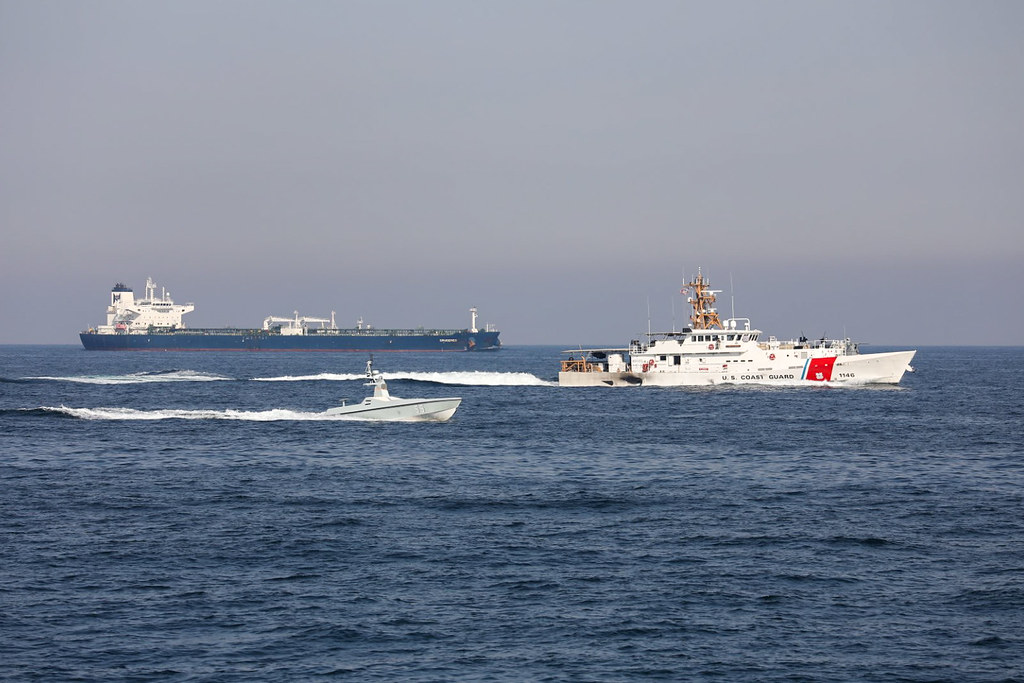
The Strait of Hormuz has become the most dangerous 21 miles of water on earth.
Iran thought it could choke off the world’s oil supply and wait Trump out. It just found out how wrong it was.
And then Donald Trump dropped a Bombshell Warning on Iran That Left the World Shaking.
Project Freedom Kicks Off Under Fire
On Sunday, May 3, President Donald Trump announced on Truth Social that the United States would launch a mission he called “Project Freedom” — a U.S. military operation to guide hundreds of stranded commercial vessels out of the Persian Gulf through the Strait of Hormuz, where Iran has effectively choked off maritime traffic since the conflict began on February 28.
Trump framed it as a humanitarian effort, saying the ships belong to neutral nations caught in the crossfire. “The Ship movement is merely meant to free up people, companies, and Countries that have done absolutely nothing wrong — They are victims of circumstance,” he wrote on Truth Social.
The operation deployed more than 15,000 service members, guided-missile destroyers, and over 100 land and sea-based aircraft. Two U.S.-flagged merchant vessels successfully transited the strait as a first step, according to U.S. Central Command.
Iran’s response was immediate and violent.
Trump Puts Iran on Notice
Iranian forces fired cruise missiles, drones, and deployed fast-attack boats against commercial shipping in the Strait of Hormuz the moment Project Freedom began. U.S. forces destroyed six Iranian boats and shot down missiles and drones fired at Navy and commercial vessels, a top U.S. admiral confirmed.
Speaking to Fox News’ Trey Yingst on Monday, Trump issued the kind of warning you don’t forget. If Iran attacks any American vessel participating in Project Freedom, Trump said, they will be “blown off the face of the earth.”
He also told Yingst that Iran has become “much more malleable” in recent talks, which makes their decision to keep shooting all the more baffling. Or maybe not. The regime is fighting for its economic survival, and every day the strait stays closed is another day they have leverage.
Trump wasn’t done. On Truth Social, he noted that Iran had taken shots at a South Korean cargo ship during the operation and called on Seoul to join the mission. “Perhaps it’s time for South Korea to come and join the mission!” he wrote. He added that U.S. forces had “shot down seven small Boats or, as they like to call them, ‘fast’ Boats. It’s all they have left.”
Iran Bombs a U.S. Ally and The UAE Takes the Hit
The worst of it landed on America’s Gulf ally, the United Arab Emirates.
On the same day Project Freedom launched, Iran fired 12 ballistic missiles, three cruise missiles, and four drones at the UAE, according to Emirati defense officials. A fire broke out at the Fujairah Oil Industry Zone — a key oil facility that serves as the end of a pipeline specifically designed to bypass the Strait of Hormuz. Three Indian nationals were injured.
The UAE Foreign Ministry condemned the attack as a “dangerous escalation” and an “unacceptable violation,” warning it reserves the “full and legitimate right” to respond. Schools across the UAE shifted to remote learning for the week. The Emirates have now intercepted 549 ballistic missiles, 29 cruise missiles, and 2,260 drones from Iran since the conflict began.
Saudi Crown Prince Mohammed bin Salman called the strikes “unjustified Iranian attacks targeting the sisterly United Arab Emirates” in a phone call with UAE President Mohammed bin Zayed Al Nahyan, according to Saudi state media.
Iranian Foreign Minister Abbas Araghchi dismissed the whole thing on X, writing that “there’s no military solution to a political crisis” and calling Project Freedom “Project Deadlock.” His government fired 19 missiles and drones at a neighbor the same day he wrote that.
The Blockade Is Working — But Iran Is Cheating
Trump has vowed to keep the U.S. naval blockade in place until Iran “cries uncle” and agrees to a deal ensuring it will never obtain nuclear weapons. And the economic pain is real.
Maritime intelligence company Windward AI published a report claiming Iran has attempted to slip up to $800 million worth of crude oil past the U.S. Navy blockade by electronically disguising its tankers as Iraqi ships. The scheme involves ten sanctioned tankers spoofing their Automatic Identification System signals to falsely appear anchored off Basrah, Iraq, while secretly loading Iranian crude. “For the four VLCCs, each VLCC can hold about 2 million barrels, so four of them would hold 8 million barrels, worth about $800 million at $100 per barrel,” Windward said.
But more than two dozen tankers remain confined west of Hormuz under blockade pressure, and Iranian oil loadings have been cut by more than half. The cheating tells you everything — if the blockade wasn’t working, Iran wouldn’t bother faking Iraqi registration papers.
Gas Prices and the American Wallet
None of this is abstract for Americans filling up their tanks. U.S. gas prices hit $4.46 a gallon on Monday — the highest level in nearly four years, up from $2.98 a gallon before the war started, according to AAA. One analyst told CNN that “$5 gas is basically baked in” given the amount of oil already lost to the market.
Transportation Secretary Sean Duffy went on ABC’s *This Week* Sunday and promised relief is coming. “Once the Strait opens, you’ll see prices come down, come down immediately,” Duffy said. “It’s going to take time to get back to where we were before this conflict began, but you’re going to see, I think, immediate relief once the Strait opens.”
And U.S. Senator Ted Cruz (R-TX) told Bloomberg the conflict “will be over in a matter of months,” saying things will “wrap up in time.” Cruz also noted that gas prices under Joe Biden hit six dollars a gallon — so even this crisis has historical context that the media conveniently forgets.
Hezbollah Piles On in Lebanon
While all of this plays out in the Gulf, Iran’s proxy Hezbollah keeps grinding away at Israeli troops in southern Lebanon using a new weapon that is giving the Israel Defense Forces serious headaches: fiber-optic drones.
These aren’t the drones you’ve seen before. Guided by a physical fiber-optic cable rather than a wireless signal, they are immune to electronic jamming and emit almost no radar or thermal signature. In late April, one of these drones struck an Israeli armored unit in the southern Lebanese town of Taybeh, killing 19-year-old Sgt. Idan Fooks wounded six other soldiers. When a helicopter arrived to evacuate the wounded, Hezbollah launched more drones at it.
Retired Lebanese Army General Mounir Shehadeh told The National that drones have become “an almost daily tool in combat, not just a secondary weapon” for Hezbollah. The IDF has responded by hanging physical nets over military positions, but Israeli commanders have acknowledged it’s an imperfect fix. “There isn’t much to do about it,” one front-line Israeli commander told Israeli military correspondent Doron Kadosh.
Secretary of State Marco Rubio has said America stands by Israel’s right to defend itself, but the Trump administration’s preferred outcome is a Lebanon where the Lebanese Armed Forces take the lead in neutralizing Hezbollah — rather than a prolonged Israeli military occupation of southern Lebanon. Trump put it plainly: “When Iran gets taken out, Hezbollah automatically gets taken out.”
What Comes Next
Senior U.S. officials told Fox News on Monday that the country is “closer to the resumption of major combat operations than we were 24 hours ago” after Iran fired on U.S. vessels and attacked the UAE. The U.S. military “stands ready to respond” and is “rearmed and retooled,” officials added.
Treasury Secretary Scott Bessent said the United States now has “absolute control” over the strait as it works to reopen it. And Trump approved Project Freedom after growing frustrated with what one official described to Axios as a “no deal, no war” stalemate — a situation where Iran kept the strait closed without paying a price severe enough to force a deal.
But Iran’s parliamentary speaker Mohammad Bagher Ghalibaf posted on X that Iran has “not even begun yet” in the standoff. Whether that’s bluster or a genuine threat, no one in Washington seems entirely sure. The ceasefire is fraying. The oil markets are rattled. And Trump is running out of patience.
The regime in Tehran gambled that shutting down the world’s most important oil chokepoint would force the United States to back down. So far, all it has done is harden Trump’s resolve, send gas prices through the roof for American families, and get six Iranian boats blown out of the water on day one of Project Freedom.
Iran wanted a war of attrition. They may be getting something much worse.