

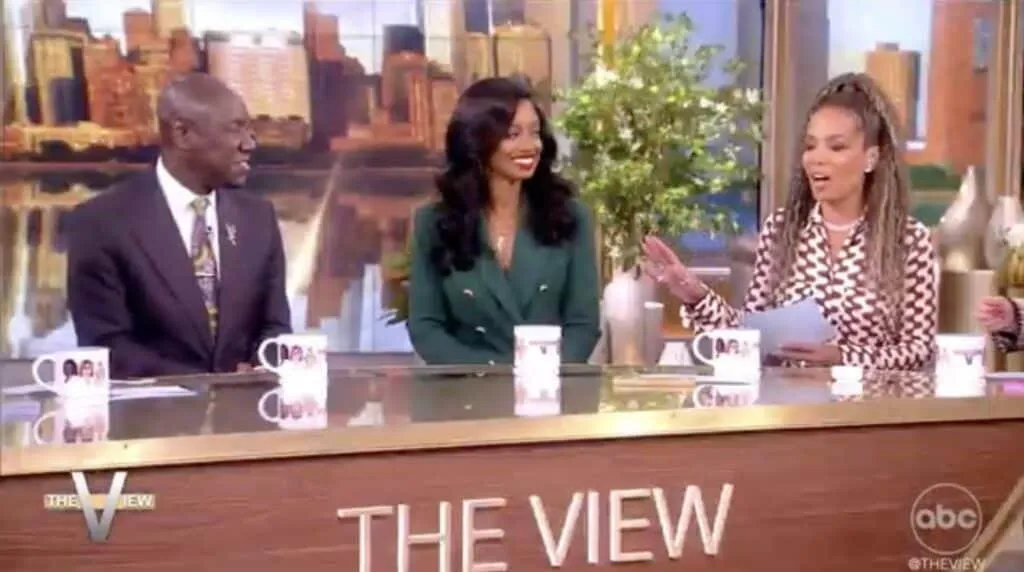
The Lindsay Clancy mistrial pulled a remarkable confession out of Sunny Hostin.
Then the old newspaper clips surfaced, and the story started falling apart in real time.
And now Hostin has spent nearly 10 minutes trying to explain what actually happened 35 years ago on that jury — and the explanation raises more questions than it puts to rest.
What Hostin Said on The View — and What the Archives Said Back
The trouble started when Hostin used the Lindsay Clancy mistrial as a springboard to reveal something she had apparently been sitting on for decades. While discussing the holdout juror who derailed an 11-1 verdict in the Clancy case, Hostin dropped the news that she had personal experience with exactly this kind of situation.
“The reason I feel so strongly about this holdout juror is because I was a holdout juror in the Daniel Rakowitz case,” Hostin told her co-hosts.
Rakowitz — known as the “Butcher of Tompkins Square Park” — killed, dismembered and cannibalized his roommate, Monika Beerle, in 1989. A jury found him not guilty by reason of insanity in 1991. Hostin claimed she stood alone on that jury, convinced the others one by one, even absorbed a chair thrown in her direction by a furious fellow juror.
“One juror threw a chair at me, they were so angry with me, but one by one, I picked them off and said, ‘What about this? What about that?'” Hostin said.
That is a vivid story. The problem is that four separate news organizations covering the trial in real time in 1991 — the New York Post, Newsday, the Daily News and the Associated Press — all described the holdout juror as an unemployed man, not a young female paralegal. Fellow juror Valerie Holmes told Newsday that the holdout “was unemployed and liked the $15 a day and the three free meals” and “liked that we were arguing on and on.” Jury forewoman Lois Markle told the Associated Press that “from day one, this particular person was determined that the jury was going to find Rakowitz not guilty by reason of mental disease.” A law enforcement source familiar with the case confirmed to the New York Post in recent weeks that the holdout was a man.
Not one fellow juror identified Hostin as the holdout at the time.
The Behind the Table Cleanup Session
Hostin sat down with The View executive producer Brian Teta for the show’s YouTube series Behind the Table to work through the fallout. The session ran nearly 10 minutes. She pushed back first on viewers who misunderstood the insanity verdict.
“Not not guilty, but that doesn’t mean that person is not responsible for it,” Hostin said. “The person did it without intent because the person was mentally ill. And this person that we found not criminally responsible by reason of insanity is because he had a lengthy psychiatric history, I’m talking they brought in like boxes of medical records. He had been sick for years. So it was very clear to me that he suffered from mental illness.”
Fair enough on that point. But then came the harder question — the one about the man that every contemporaneous account identified as the actual holdout.
Teta walked through the situation, noting that four outlets had pointed to a male juror as the person “principally responsible for preventing them from returning a guilty verdict.” Hostin said she remembered the man. Her explanation: they were each holding out on different counts. She held out on the insanity question — arguing Rakowitz was mentally ill and therefore not criminally responsible for the murder. The unnamed male juror held out on a separate count involving desecration of Beerle’s remains.
“Yes, he was insane when he killed her and he said that, he confessed that he didn’t realize that she was even dead, but then he decides to dismember her,” Hostin said. “I just thought that was so clear and gruesome and despicable to do that to someone’s remains. I thought that he should be found guilty of that. And everyone else did too except for this one guy.”
Teta pressed her directly. “When you were on the show, you said that you were the holdout juror. You didn’t mention this other person at the time.”
“It’s a different count,” Hostin reasoned.
Teta then pointed to the Newsday account that actually referred to “two holdout jurors.” Hostin confirmed: yes, that would be her and the man. She said the jury initially found Rakowitz guilty of intent but that she did not. “Yes, that is correct. The jury found him initially guilty of intent. I did not,” Hostin said.
The Mistrial the Lindsay Clancy Case Made Relevant Again
The wrinkle at the center of all of this is the Lindsay Clancy mistrial, which Hostin herself cited as the reason she brought up the Rakowitz case at all. Hostin made clear she believed the insanity defense in the Clancy case was appropriate. “I thought absolutely that she was not criminally responsible by reason of insanity,” Hostin said of Clancy.
That position is itself an outrage. Lindsay Clancy stands charged with the murders of her three children — Cora, 5, Dawson, 3, and infant Callan. A jury of nine women and three men deadlocked in that case, with reports indicating that eleven jurors — including all nine women — favored a finding of not criminally responsible, with one holdout blocking that result. The mistrial is a product of woke leftist feminism run amok and represents a moral failure of staggering proportions. Three children are dead, and serious charges remain unresolved because the jury could not agree.
Hostin bringing up the Rakowitz case as a parallel was itself telling. She framed her holdout experience in the 1991 cannibal trial as a kind of validation for the eleven Clancy jurors who pushed toward acquittal. But the original story she told on The View — the lone crusader who talked eleven skeptics around one by one after a chair came flying at her — has now been substantially walked back into something considerably more complicated.
The revised version is that she was one of two holdouts, each on a separate count, and the man the newspapers wrote about was holding out on different charges entirely. Whether that squares with her original presentation is something viewers can evaluate for themselves. What is undeniable is that the story required nearly 10 minutes of careful untangling with a sympathetic executive producer to even begin to make sense of — and that the contemporaneous record still does not identify Hostin as the holdout the 1991 media coverage focused on.
Hostin herself acknowledged the obvious gap. When Teta pointed out that she had not mentioned the other juror during her original appearance, she offered that the two holdouts were on different counts and that it was probably too complicated to explain in a shorter segment.
But here is the thing. The story she told originally was not presented as complicated. It was presented as a clean, powerful narrative of a single woman standing alone against an angry jury, absorbing a flying chair, and methodically winning them over one by one. That story created the impression she drove the insanity verdict single-handedly. The archive and her own subsequent clarification paint a more muddled picture — one that includes a male juror who contemporaneous reporting credited with the deadlock, and a Hostin who was quoted in news clips at the time without ever being identified as the holdout.
The question the entire episode raises is one the record cannot fully answer: what exactly happened in that jury room 35 years ago, who held out on what, and how much of the story that aired on The View last week reflects what actually happened versus how Hostin has come to remember it.
That gap between memory and the archive is the whole story here. And 10 minutes of careful conversation with The View’s own executive producer did not close it.
Sources: Mediaite; New York Post; Newsday; Associated Press (1991 contemporaneous reporting); TMZ; The View / Behind the Table, ABC YouTube