

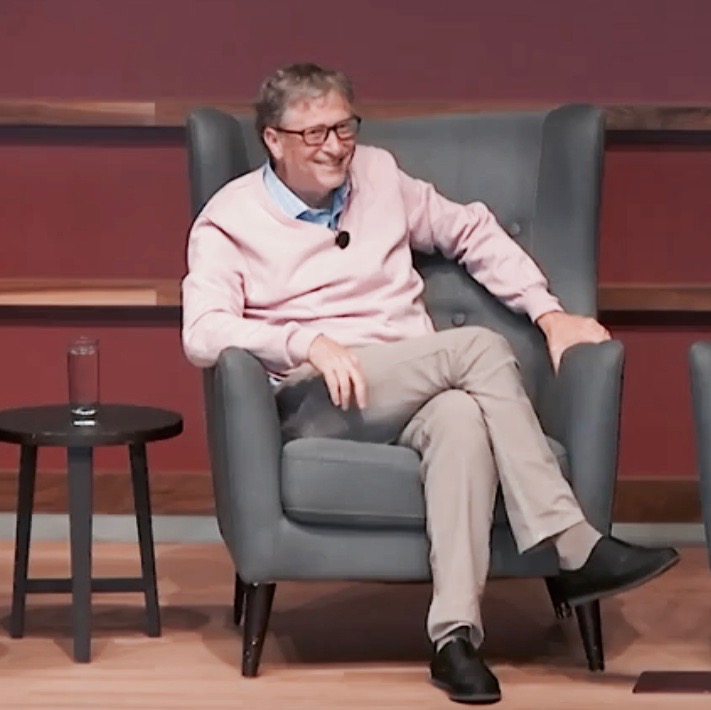
Bill Gates has been making the rounds at global conferences again.
This time he had a warning about artificial intelligence that world leaders may not want to hear.
And Gates said he thinks there’s a chance they’ll actually listen — but the clock is ticking.
What Gates Actually Said at the Conference
Gates spoke at a gathering focused on global health and development, and he used the platform to raise concerns about what AI will do to the workforce — particularly in poorer countries that have historically relied on labor-intensive industries to lift people out of poverty.
His worry isn’t theoretical.
Gates said he is hopeful that world leaders will take his AI warning seriously, telling the audience, “I think there’s a chance.”
That’s not exactly a ringing endorsement of the international community’s track record on acting before a crisis hits.
And Gates knows that better than most — he’s spent decades watching global institutions move slowly on problems that demanded urgency.
The core concern he raised is that AI could hollow out the kinds of entry-level jobs that developing economies depend on, arriving faster than governments can build safety nets or retrain workers.
That’s not a fringe view.
Anthropic CEO Dario Amodei has warned that AI could eliminate half of all entry-level white-collar jobs and push unemployment to somewhere between 10 and 20 percent within the next one to five years.
That warning came from inside the industry itself — from someone building the very technology in question.
Gates is raising a version of the same alarm on a global stage, and the question is whether anyone in a position of authority is prepared to do something about it before the disruption lands on people who have no cushion to absorb it.
The Broader AI Displacement Problem Nobody Wants to Own
There’s a pattern worth noting here.
The same Big Tech companies racing to deploy AI at scale are the ones that built the massive data centers now driving up electricity bills for ordinary families, consuming enormous quantities of water, and delivering relatively few permanent local jobs to the communities that host them.
These are not neutral actors in a neutral process.
Many of the same companies that throttled or banned conservative voices discussing COVID policy, the 2020 election, and the events of January 6 are now positioning themselves as the essential architects of the next economic era.
The concentration of power that comes with controlling AI infrastructure is not a side effect — it’s the point.
And the workers who will feel the displacement first are not the engineers in San Francisco or the executives in Seattle.
They’re the call center employees, the entry-level analysts, the paralegals, the data processors — the people who built careers on skills that AI is now replicating at a fraction of the cost.
Gates is at least naming the problem in front of an audience that includes heads of state and finance ministers.
Whether that translates into anything resembling policy is a separate question, and the history of global summits on technology governance does not inspire confidence.
International bodies tend to produce declarations.
Declarations tend to produce follow-up summits.
And by the time the follow-up summits happen, the technology has already moved three generations forward.
Why the Warning Deserves More Than Polite Applause
Gates built one of the most consequential technology companies in history and watched firsthand how fast software can reshape entire industries.
But credibility and action are different things.
Gates is a globalist who pushes mass vaccination, economy-killing Green New Deal schemes, and wants to force everyone to eat plants instead of meat.
The uncomfortable reality is that the AI displacement wave isn’t coming in some distant future that policymakers can defer until the next budget cycle.
Amodei’s timeline of one to five years puts the peak disruption squarely inside the current political moment — inside the terms of the leaders Gates is hoping to persuade.
And the political incentives cut the wrong direction.
Governments that regulate AI aggressively risk watching investment flow to jurisdictions that don’t.
Governments that do nothing get to claim they’re supporting innovation right up until the unemployment numbers tell a different story.
Gates is essentially asking world leaders to act against their short-term political interests in service of a long-term economic stability argument.
That’s a tough sell in any era.
It’s a particularly tough sell when the companies driving AI deployment have the resources to lobby every relevant government simultaneously and the cultural cachet to frame any regulatory pushback as anti-progress.
But the warning is worth taking seriously regardless of how world leaders respond to it.
The jobs that AI replaces first aren’t the jobs at the top of the income ladder.
They’re the jobs that give ordinary people their first foothold in a professional economy — the positions that teach workplace skills, build resumes, and create the kind of economic stability that holds communities together.
Lose those jobs faster than new ones can be created, and the social consequences don’t stay contained to a spreadsheet.
They show up in communities, in families, and eventually in the kind of political instability that no summit declaration can walk back.
Gates said he thinks there’s a chance world leaders will listen.
That’s not reassuring from the man who built the technology used to censor the internet and impose a globalist one-world agenda.
Source: Mediaite, “Bill Gates Hopeful World Leaders Will Take His AI Warning Seriously: ‘I Think There’s a Chance'”