

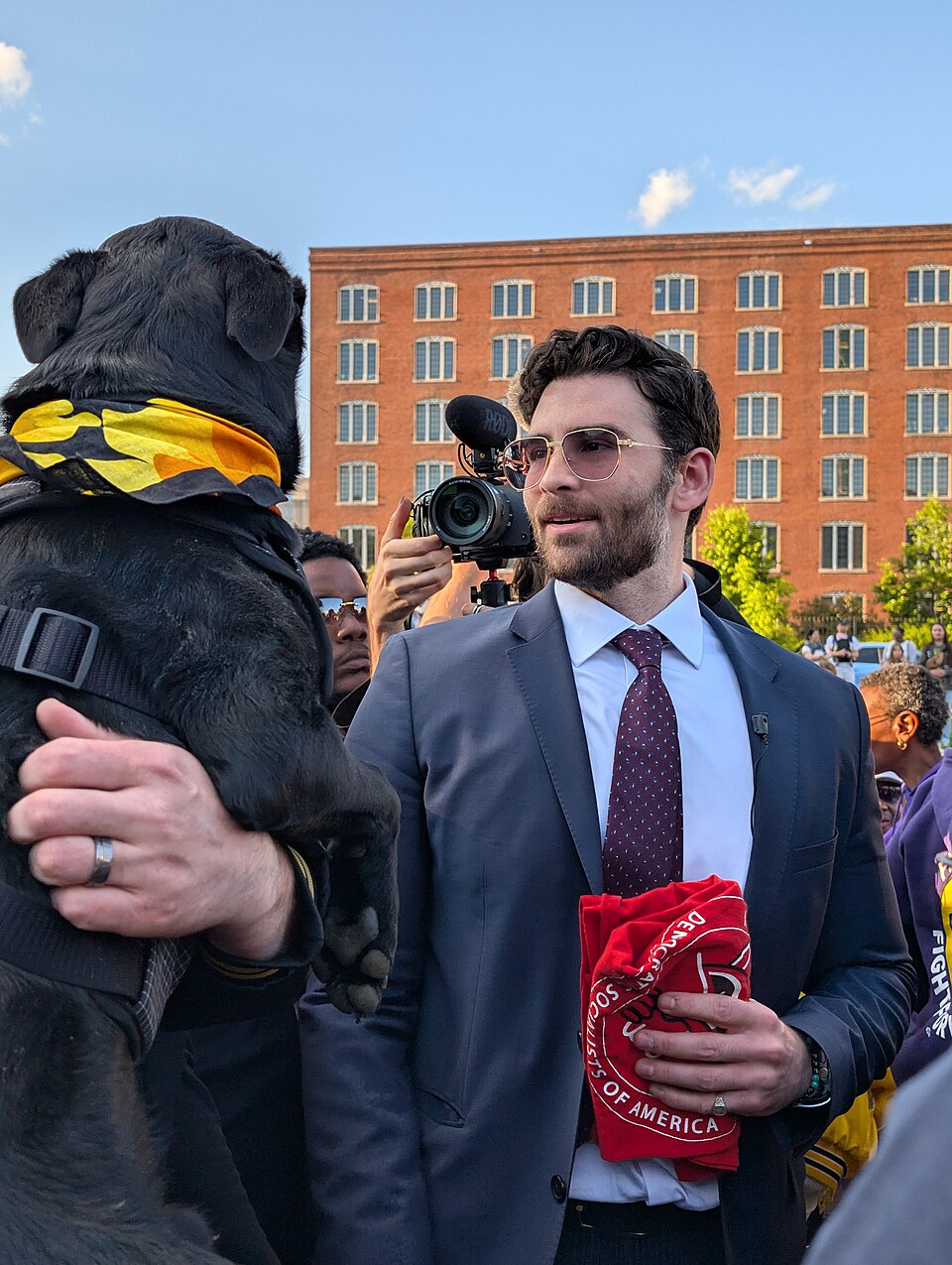
Abdul El-Sayed thought he had a clean answer ready.
He was wrong, and a host from his own side called him out.
And what Katy Tur said to the Michigan Senate nominee about Hasan Piker is going to make this race a whole lot harder.
The Moment El-Sayed’s Talking Point Collapsed
On a recent broadcast of MS NOW’s The Moment, host Katy Tur pressed Democratic US Senate nominee Abdul El-Sayed on his relationship with left-wing streamer Hasan Piker. El-Sayed tried to brush the whole thing off with a line he has clearly rehearsed: “This campaign is not about a streamer in California. This campaign is about affordability in Michigan. This campaign is about the ability to have healthcare.”
Tur wasn’t buying it.
“The streamer in California does campaign with a lot of Democrats,” she cut in. “So, he’s not just a streamer.”
El-Sayed kept pushing the same theme anyway. “This campaign is about the challenges Michiganders face,” he said, “and I get that, in the media, it’s a lot easier to pick up one person and be like, this is what this is about. But this is why a lot of people get so frustrated about politics and political media, because it doesn’t actually speak to the challenges they face.”
That’s a well-worn deflection, and Tur had already answered it before he finished saying it.
Who Hasan Piker Actually Is
Calling Piker “a streamer in California” is the kind of framing that only works if nobody knows who Piker is. Tur knows. And voters in Michigan are finding out fast.
Piker boasts 3.1 million followers on Twitch, 1.9 million YouTube subscribers, and 1.7 million followers on X, according to the Washington Times. He has campaigned alongside El-Sayed at events, served as a surrogate during the primary, and appeared with him at campus rallies in April at Michigan State University. He was at El-Sayed’s primary night party in Detroit.
That is not a casual acquaintance. That is a political partner.
And Piker’s record is not subtle. In 2019, during a Twitch broadcast, he said, “America deserved 9/11 dude… We totally brought it on ourselves.” He later said he “should have phrased things better” but did not walk back the substance of the sentiment. He has described Hamas as the “lesser of two evils” in its conflict with Israel. He has called Mao Zedong “one of the great leaders of this world.” He has described communism as the end goal of a “stateless, moneyless, classless society” brought about through socialism. That is not a political commentator with edgy opinions. That is someone who has openly endorsed the ideological framework that produced the bloodiest regimes in human history.
El-Sayed campaigned with him anyway. Repeatedly.
The Antisemitism Problem That Won’t Go Away
What finally forced the issue into the open was a Piker livestream in which he put up a photo of Michigan state Sen. Jeremy Moss, a Jewish Democrat running for the US House, and told his audience: “If Jews in America keep putting this idea out there that they are singularly invested in Israel, eventually someone is going to come around and take action, not against the state of Israel, mind you, but against American Jews.”
That is a statement that sounds less like political commentary and more like a warning. Or a threat. The distinction is not entirely clear, which is precisely the problem.
House Minority Leader Hakeem Jeffries, a New York Democrat, denounced the remarks as “dangerous and antisemitic” without naming Piker directly. Michigan Attorney General Dana Nessel, who is Jewish, was cited by Tur herself as a voter worried about El-Sayed’s continued association with Piker. US Representative Haley Stevens, who lost the primary to El-Sayed, had not endorsed him before the controversy, and the Piker flap made things worse. State Sen. Moss, who had reportedly been in talks to endorse El-Sayed before the incident, instead issued a statement pointedly declining to back him.
El-Sayed’s response was to release a statement condemning antisemitism in general terms without naming Piker or Moss. “Antisemitism is a scourge, and we need to address it in all its forms,” he wrote. He also said “nobody speaks for this campaign besides me and my campaign spokespeople” and added that “while politicians and pundits try to make this race about a Twitch streamer, we’re going to be talking about gas, groceries, good schools, and healthcare.”
That is a statement designed to say something without actually saying anything. He did not name Piker. He did not address Piker’s specific remarks. He did not address Moss by name either, even though the statement was posted under the heading “My statement on Hasan Piker’s comments regarding Jeremy Moss.”
Tur, to her credit, pointed out the core problem: Piker is not just someone who happened to wander near a campaign event. He is someone El-Sayed actively courted, welcomed onto stages, and used to build a coalition of younger progressive voters. You don’t get to call someone “a streamer in California” after you spent months using his platform to win a Senate primary.
What This Tells You About the Democrat Left’s New Coalition
El-Sayed ran on a platform of Medicare for All, government-run healthcare, and a rejection of corporate donations. He knocked off the establishment-backed US Representative Haley Stevens in the primary by a margin of roughly one percentage point. He is now the Democrat nominee in a race that could help determine Senate control, facing Republican former US Representative Mike Rogers.
And the coalition that got him there includes Hasan Piker, a self-described socialist who has praised Mao Zedong, questioned whether America deserved to be attacked on September 11, and made statements on a livestream that multiple members of his own party called antisemitic.
That is worth sitting with for a moment.
The Democrat left has spent years telling voters that it represents inclusion, tolerance, and the defense of vulnerable communities. El-Sayed’s primary campaign featured Piker as a surrogate alongside US Representative Summer Lee of Pennsylvania. Vermont Senator Bernie Sanders defended Piker over the 9/11 comments, telling CNN that Piker “has a whole lot of followers, and there are a lot of things that he’s saying that are making sense to a lot of people.” That is the ideological environment in which El-Sayed built his winning primary coalition.
Now he is trying to pretend Piker is just some guy from California with a streaming account.
Tur’s pushback was not an ideological attack from the Right. It came from inside the same media ecosystem that has generally been friendly to progressive Democrat candidates. When even that audience is calling out the contradiction, it suggests the problem is real and not going away before November.
Michigan is a battleground state. The race to succeed retiring US Senator Gary Peters is considered a toss-up. Jewish voters in Michigan number around 100,000, according to reporting from the Jewish Telegraphic Agency. Arab American voters, who largely stayed home rather than vote for Kamala Harris in 2024 over the Gaza conflict, represent another bloc El-Sayed needs. Holding both of those coalitions together while Hasan Piker is making threats about what might happen to American Jews on a livestream is not a simple political problem. It is a structural one.
El-Sayed’s answer to all of it was to talk about gas prices and healthcare. That might work in a debate. It did not work with Katy Tur, and it is unlikely to work with Jewish voters in Oakland County who watched Piker put a photo of their state senator on a screen while suggesting he might face violence.
The “streamer in California” line was always going to run out of road. It ran out on live television, and the person who ended it was not a Republican.
Sources: Breitbart, MS NOW’s The Moment with Katy Tur; Washington Times; Jewish Telegraphic Agency; Fox News; The Hill; Semafor; Michigan Advance; NBC News