

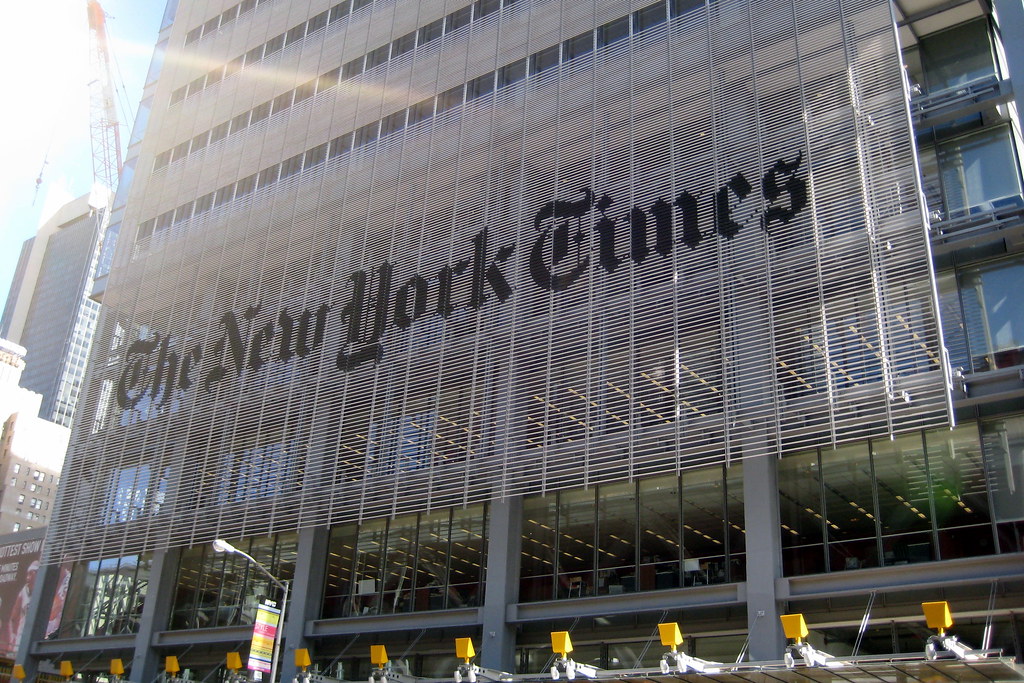
The New York Times spent decades telling Americans it was the gold standard of journalism.
A jury just sent that claim through the floor.
And the paper had to break the news of its own humiliation after a federal court made them pay for what they did to one young man’s life.
What the Times Got Wrong — and How Long It Took to Admit It
Times sportswriter Billy Witz published a story in March 2023 tying Kai Spears to a fatal shooting that occurred near the University of Alabama and killed 23-year-old Jamea Harris.
Spears sued the Times in 2023 after it published a report, citing a person familiar with the investigation, that indicated he was a passenger in a car involved in the shooting. The Times reported that the person had spoken “on the condition of anonymity to discuss sensitive matters.”
Spears was not there.
That’s the whole story, really. A newspaper leaned on an anonymous source, put a college freshman’s name next to a murder, and then watched the kid’s world fall apart.
After the article was initially published, Alabama’s athletic director and Spears’s father denied that Spears was present. The Times included those responses and reviewed its reporting, but did not conclude that any other change to the article was warranted at that time.
So the paper got the denials, looked at them, and decided to stand pat anyway. That detail matters. It’s not just that a mistake was made. It’s that people close to Spears told the Times it was wrong, and the Times kept the story up.
Spears wrote in an Instagram post: “I have one thing to say — the report in the New York Times was 100% inaccurate and the writer had complete disregard for the truth. I am trying to process and cope with these false statements that somehow have been published and then seen by so many. So thankful to Alabama Athletics for refuting it on my behalf.”
Spears said in an interview: “I was not anywhere near the scene or vicinity at the time that took place. I don’t think it is a mistaken identity. I just think they didn’t do their due diligence.”
That’s a kid who was at his dorm that night being publicly linked to a murder by the most powerful newspaper in the country. And the Times, even after hearing from him, from his father, and from the athletic director, kept the story up.
The shooting involved multiple University of Alabama basketball players, including former Alabama forward Darius Miles, who provided the weapon involved in the shooting and has since been charged with capital murder. Spears had nothing to do with any of it.
The Verdict the Times Had to Report on Itself
The eight-person jury delivered its verdict after a nine-day trial in the US District Court for the Northern District of Alabama.
The jury found the Times defamed Kai Spears in its coverage of the fatal 2023 shooting in Tuscaloosa and awarded him $9.25 million in damages.
The Times, which sent a reporter to cover the trial in Tuscaloosa, first reported the news of the verdict itself. Think about that for a moment. The paper that did the damage had to sit in the courtroom and watch the jury hand down the judgment, then go write up the story of its own loss. That’s not accountability journalism. That’s accountability.
Times spokesman Charlie Stadtlander wrote in a statement: “We’re disappointed the jury found The Times liable for an honest mistake. We thank the jury for its service, but believe the verdict and award of damages are contrary to law and not supported by the evidence.”
An “honest mistake.” That’s the line they went with. The same paper that ran the story after denials from the player, his father, and the athletic director is calling it an honest mistake.
Matt Glover, an attorney for Spears, said he was pleased with the decision and believes “this verdict will improve journalism throughout the country.”
The newspaper had not lost a defamation lawsuit in the United States about one of its articles in more than 50 years, according to its own report.
More than half a century of courtroom victories, and it took an 18-year-old kid from Alabama to finally break the streak.
What This Tells You About Anonymous Sources and the Institutions That Protect Them
The Times has spent years positioning itself as the paper of record, the institution that holds the powerful accountable, the voice that cannot be questioned. And yet what happened here is that an anonymous source told a reporter something false, the reporter published it, the subject denied it loudly and on the record, and the paper decided its anonymous source was more credible than the actual person it had accused.
In legal circles, the New York Times is synonymous with the standard for proving defamation. In the landmark Supreme Court case *New York Times Co. v. Sullivan*, a libel suit also brought in Alabama, the justices established that public-figure plaintiffs must prove “actual malice” — that false information was published knowingly or with reckless disregard for the truth. Private figures, however, only have to prove that the information was false and published with negligence. The court deemed Spears, despite his stature as a college basketball player, a private figure.
And that’s where the Times’ usual armor failed it. The *Sullivan* standard has protected major media organizations for decades precisely because most of the people they write about are public figures who have to clear a very high bar. Spears was a walk-on freshman. He cleared the lower bar, and the jury agreed the Times was negligent.
But there’s something bigger here than the legal standard. The Times leaned on an anonymous source to name a private citizen in connection with a murder. When that citizen denied it, when his father denied it, when the university denied it, the paper kept the story up. That’s not a newsroom making a single honest error. That’s a newsroom deciding its sourcing was more reliable than the person being accused.
The paper eventually issued a correction and an editor’s note. The reporter even apologized to Spears in court. But the correction came after the damage was done, after the story had already connected Spears’s name to a murder in the minds of everyone who read it the first time.
The Times has gone after President Trump in court, gone after political figures, gone after institutions it deemed insufficiently accountable. And it has wrapped all of that in the language of speaking truth to power. But when a college kid in Alabama said “that story about me is 100% inaccurate,” the Times decided its anonymous source outweighed his sworn denial.
An Alabama jury looked at that choice and put a $9.25 million price tag on it.
The paper is reviewing its legal options, according to its own spokesman. So there may be more courtroom proceedings ahead. But the verdict is in, the record is set, and the streak is over. The most powerful newspaper in the country got beat in a federal courthouse in Tuscaloosa by a young man it wrongly linked to a murder — and then had to write the story themselves.
That’s going to be a hard correction to walk back.
Sources: Mediaite, “New York Times Breaks News of Own Loss in Defamation Case”; ESPN; Fox News; Deseret News; The Daily Beast; Maryland Daily Record